
Callosamia angulifera
Walker, 1855
Tuliptree Silkmoth, Giant Silkmoth
Callosamia angulifera is a large saturniid native to eastern North America. are , with activity occurring from June through August in northern and March through August in southern populations where two occur annually. The exhibits strong plant specificity, with larvae feeding exclusively on tulip tree (Liriodendron tulipifera). Adults lack functional mouthparts and do not feed. The species is closely related to Callosamia promethea and C. securifera, with which it shares morphological similarities but differs in host plant use and diel activity patterns.


Pronunciation
How to pronounce Callosamia angulifera: /kælˈoʊseɪmiə ænˌɡjuːləˈfɪərə/
These audio files are automatically generated. While they are not always 100% accurate, they are a good starting point.
Identification
Distinguished from congeneric primarily by plant association with Liriodendron tulipifera. Callosamia promethea utilizes multiple host plants including Syringa, Prunus, and Sassafras. Callosamia securifera (sweetbay silkmoth) is restricted to Magnolia virginiana. C. angulifera is entirely , whereas C. carolina (now C. securifera) is with mating activity confined to 10 a.m. to 3 p.m., providing reproductive isolation. Larvae of C. angulifera at first instar are phenotypically indistinguishable from C. promethea. Cocoon structure differs from C. promethea: C. angulifera gathers several leaves as a cover and lacks the stalk-sheathing characteristic of C. promethea, resulting in cocoons that commonly fall to ground with shed leaves.
Images
Appearance
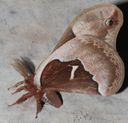
Wingspan 80–110 mm. Large-bodied silkmoth with characteristic saturniid . present; males have more feathery than females. Coloration and detailed wing patterning not explicitly described in available sources.
Habitat
Associated with forests and woodlands containing tulip tree (Liriodendron tulipifera), the exclusive larval plant.
Distribution
Eastern North America: Massachusetts east through central New York, southern Ontario, and southern Michigan to central Illinois, south to the Florida panhandle and Mississippi.
Seasonality
One annually in northern range ( June–August); two generations in southern range (adults March–April and August).
Diet
Larvae feed exclusively on leaves of Liriodendron tulipifera (tulip tree). do not feed.
Host Associations
- Liriodendron tulipifera - obligate larval exclusive food plant for larvae; no alternative documented
Life Cycle
Complete with one per year in northern , two generations per year in southern populations. Cocoon spun among gathered leaves, lacking attachment to parent tree; commonly falls to ground when leaves shed. stage not explicitly documented in sources but inferred as pupa within cocoon based on typical saturniid pattern.
Behavior
activity pattern; mating and occur at night. Larval food selection is genetically determined and -specific. Cocoon-spinning behavior involves gathering multiple leaves rather than rolling a single leaf tube; lacks stalk-sheathing behavior seen in C. promethea.
Ecological Role
herbivore on tulip tree. Role in not extensively documented; likely serves as prey for birds, small mammals, and . may contribute to nutrient cycling through non-feeding adult stage.
Human Relevance
Subject of entomological study due to specificity and hybridization potential with congeneric . Occasionally encountered by naturalists and enthusiasts. Not documented as agricultural pest or economically significant species.
Similar Taxa
- Callosamia prometheaOverlapping range and morphological similarity; distinguished by larval diet (Syringa, Prunus, Sassafras), mating activity in some , and cocoon attached to parent tree via stalk-sheathing
- Callosamia securiferaFormerly C. carolina; distinguished by mating activity (10 a.m.–3 p.m.), exclusive association with Magnolia virginiana, and double-brooded cycle in its native range
Sources and further reading
- BugGuide
- Wikipedia
- GBIF taxonomy match
- iNaturalist taxon
- NCBI Taxonomy
- Catalogue of Life
- Sphingidae | Beetles In The Bush | Page 2
- The Moth and Me | Beetles In The Bush
- Saturniidae | Beetles In The Bush | Page 2
- Noctuidae | Beetles In The Bush | Page 3
- Megacyllene comanchei revisited | Beetles In The Bush
- Note On the Inheritance of Behavior Patterns for Food Selection and Cocoon Spinning in F 1 Hybrids of Callosamia Promethea x c. Angulifera
- Mating Behavior and Life Habits of the Sweet-Bay Silk Moth ( Callosamia carolina )