
Hemileuca nuttalli
Strecker, 1875
Nuttall's Sheep Moth, Nuttall's Buck Moth
Hemileuca nuttalli, or Nuttall's sheep moth, is a medium-sized saturniid native to western North America. It is one of approximately 24 in the Hemileuca, commonly known as buck moths or sheep moths. The species exhibits distinctive yellow-orange and black wing patterning and has urticating larvae that feed on woody shrubs. are and do not feed. In behavioral studies, male H. nuttalli showed no attraction to Argiope aurantia spider lures, unlike some closely related species, suggesting potential -prey coevolutionary dynamics.

Pronunciation
How to pronounce Hemileuca nuttalli: /hɛmɪˈluːkə nʌˈtælaɪ/
These audio files are automatically generated. While they are not always 100% accurate, they are a good starting point.
Identification
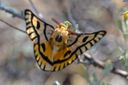
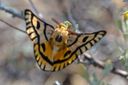
Distinguished from other Hemileuca by the combination of yellow-orange hindwings with a thick curved black stripe, forewings with yellow-to-white gradient, and specific eyespot pattern (black with white center on forewings, small black eyespot on hindwings). The 60–65 mm wingspan is relatively small for the . Males of H. nuttalli can be distinguished from H. hera and H. magnifica by their lack of attraction to Argiope aurantia spider lures in behavioral assays.
Images
Habitat
Grassland and shrub-dominated . typically fly well above vegetation . Associated with plants including Purshia tridentata (bitterbrush), Symphoricarpos (snowberries), and Ribes species (currants/gooseberries).
Distribution
Western North America: south-eastern British Columbia, eastern Washington, eastern Oregon, north-eastern California, Idaho, Nevada, northern Arizona, Utah, Montana, Wyoming, Colorado, and north-western New Mexico.
Diet
Larvae feed on Purshia tridentata, Symphoricarpos , and Ribes species. lack functional mouthparts and do not feed.
Host Associations
- Purshia tridentata - larval bitterbrush
- Symphoricarpos - larval snowberry
- Ribes - larval currant and gooseberry
Life Cycle
Females lay in rings around small twigs of plants. Larvae are black with yellow urticating spines. are short-lived and do not feed.
Behavior
activity. Males engage in circular locating flights (500 m to 1 km diameter) when searching for females, then follow gradients (~100 m) to locate calling females. When a pheromone plume is detected, flight paths become smaller in diameter to map geospatial pheromone concentrations. Males showed no attraction to Argiope aurantia spider pheromone lures in experimental studies, unlike H. hera and H. magnifica.
Ecological Role
Human Relevance
Larvae can deliver stings upon contact due to urticating spines. Occasionally referenced in entomological collections and biodiversity studies. No significant economic impact documented.
Similar Taxa
- Hemileuca heraSimilar size and coloration; males strongly attracted to Argiope aurantia lures, unlike H. nuttalli
- Hemileuca magnificaClosely related in same clade; males strongly attracted to Argiope aurantia lures, unlike H. nuttalli
- Hemileuca eglanterinaAnother sheep moth with variable coloration; differs in geographic range and lure response patterns
More Details
Taxonomic history
Originally described as Pseudohazis nuttalli by Ferdinand Heinrich Hermann Strecker in 1875.
Phylogenetic context
Molecular phylogenetic studies place H. nuttalli in a clade with H. hera and H. magnifica, yet it exhibits a distinct behavioral phenotype regarding lure response.
Sources and further reading
- BugGuide
- Wikipedia
- iNaturalist taxon
- NCBI Taxonomy
- Sheep Moths Draw Attention at Bohart Museum of Entomology Open House | Bug Squad
- UC Davis Bio Boot Camps: Where Science Matters | Bug Squad
- Grasshoppers of Colorado
- Look but do not touch: puss caterpillar, Megalopyge opercularis; White flannel moth, Norape ovina; Io moth, Automeris io; buck moth Hemileuca spp.; and hag moth, Phobetron pithecium — Bug of the Week
- Friday Flower – Sedum pulchellum | Beetles In The Bush
- Bug Eric: Giant Silkmoths
- Fatal Attraction: Argiope Spiders Lure Male Hemileuca Moth Prey with the Promise of Sex