
Lampronia corticella
(Linnaeus, 1758)
Raspberry Moth
Lampronia corticella, commonly known as the raspberry , is a small moth in the Prodoxidae. First described by Linnaeus in 1758, it is native to most of Europe and has been introduced to North America, where it was first detected in New Brunswick, Canada in 1936. The is associated with Rubus species as larval .
Pronunciation
How to pronounce Lampronia corticella: //læmˈproʊniə kɔːrˈtɪsɛlə//
These audio files are automatically generated. While they are not always 100% accurate, they are a good starting point.
Identification
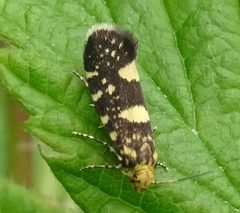
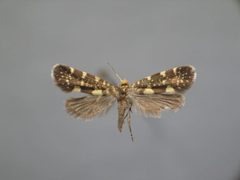
Distinguished from similar small Prodoxidae by the specific pattern of pale ochreous-yellowish spots on the forewings: four small costal spots and two larger spots. The combination of dark fuscous ground color with scattered pale dots and whitish cilia tips is diagnostic. Dark grey hindwings contrast with the patterned forewings.
Images
Appearance
Small with wingspan of 10–12 mm. light yellow-ochreous mixed with fuscous. Forewings dark fuscous with scattered pale yellowish dots; four small costal and two larger pale ochreous-yellowish spots present; cilia tips whitish. Hindwings dark grey.
Distribution
Native to most of Europe, excluding Iceland, the Iberian Peninsula, and the Balkan Peninsula. Introduced to North America; first detected in New Brunswick, Canada in 1936.
Diet
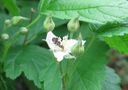
Larvae feed on Rubus .
Host Associations
- Rubus - larval of brambles and raspberries
Human Relevance
Considered a pest of raspberry due to larval feeding on Rubus . Its introduction to North America likely occurred through human-mediated transport of plants.
Similar Taxa
- Other Lampronia speciesSimilar size and general appearance; distinguished by specific forewing spot pattern and association
- Small IncurvariidaeFormerly classified in this ; may share general but differ in wing pattern details
More Details
Taxonomic history
Has been classified in Incurvariidae in some treatments; currently placed in Prodoxidae. GBIF lists it as a synonym of Incurvaria rubiella, though Catalogue of Life and NCBI maintain it as a valid under Lampronia.