
Coptodisca powellella
Opler, 1971
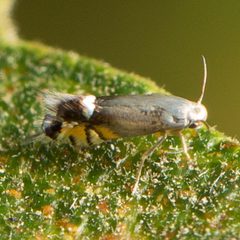
Coptodisca powellella is a small in the Heliozelidae, described by Paul A. Opler in 1971. It is to California and is associated with coast live oak (Quercus agrifolia). The larvae are leaf miners, creating distinctive feeding patterns within the leaves of their plant.
Pronunciation
How to pronounce Coptodisca powellella: /ˌkɒptoʊˈdɪskə ˌpaʊɛˈlɛlə/
These audio files are automatically generated. While they are not always 100% accurate, they are a good starting point.
Identification
Distinguished from other Coptodisca by geographic restriction to California and specific association with Quercus agrifolia. Leaf mines on coast live oak with associated specimens provide the most reliable identification. Genitalia dissection may be required for definitive species-level identification.
Images
Appearance
Small ; are not well described in available literature. As a member of Heliozelidae, adults likely have narrow wings with reduced venation and characteristic metallic or iridescent scaling. Larvae are internal feeders within leaf tissue.
Habitat
Associated with stands of coast live oak (Quercus agrifolia) in California. Specific conditions (elevation, moisture, temperature regimes) are not documented.
Distribution
to California, United States. Specific counties or regions within California are not detailed in available sources.
Seasonality
period and larval activity timing are not documented in available literature.
Diet
Larvae feed on Quercus agrifolia (coast live oak), mining within the leaves. feeding habits are unknown.
Host Associations
- Quercus agrifolia - larval Coast live oak; larvae mine leaves
Life Cycle
Larvae mine leaves of Quercus agrifolia. Specific details regarding placement, site, number of per year, and stage are not documented.
Behavior
Larvae create internal leaf mines in Quercus agrifolia foliage. is not described in available sources.
Ecological Role
As a , larvae may contribute to localized reduction in photosynthetic capacity of leaves. -level impacts on Quercus agrifolia are not documented. Serves as a herbivore in oak-associated .
Human Relevance
No documented economic or ecological significance to humans. Of potential interest to lepidopterists and those studying California insects.
Similar Taxa
- Other Coptodisca speciesNumerous exist, many also associated with oak ; geographic distribution and plant specificity are primary distinguishing features
- Other Heliozelidae leaf minersSimilar leaf mining habits; identification requires examination of or molecular analysis
More Details
Taxonomic history
Described by Paul A. Opler in 1971. The specific epithet honors an individual, though the etymology is not detailed in available sources.
Research gaps
Basic biological information including , period, and complete remain undocumented in accessible literature.