
Coptodisca arbutiella
Busck, 1904
madrone shield bearer
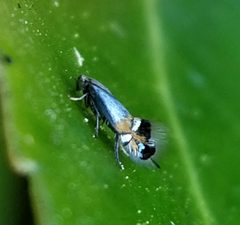
Coptodisca arbutiella, commonly known as the madrone shield bearer, is a small in the Heliozelidae. It was first described by August Busck in 1904. The is restricted to western North America and is tightly associated with Arbutus plants. Its larvae are leaf miners that produce distinctive blotch-like mines.
Pronunciation
How to pronounce Coptodisca arbutiella: //kɒpˈtoʊ.dɪs.kə ˌɑːr.bjʊˈtiː.ɛl.lə//
These audio files are automatically generated. While they are not always 100% accurate, they are a good starting point.
Identification
This can be distinguished from other Heliozelidae by its association with Arbutus plants and the blotch-like leaf mines produced by its larvae. identification to species level requires examination of genitalia or molecular analysis.
Images
Habitat
Occurs in areas where Arbutus grow, including coastal and montane forests of western North America.
Distribution
Western North America, from California north to British Columbia.
Diet
Larvae feed on Arbutus .
Host Associations
- Arbutus - larval Larvae mine the leaves of their plant.
Behavior
Larvae mine leaves of plants, producing blotch-like mines.
Ecological Role
Leaf-mining larvae may influence leaf longevity and photosynthetic capacity of Arbutus plants.
Similar Taxa
- Other Coptodisca speciesShare Heliozelidae and leaf-mining habit; require detailed examination to distinguish.
More Details
Leaf mine morphology
The larval mine is described as blotch-like, distinguishing it from linear mines produced by some related leaf-mining .