
Antispila nysaefoliella
Clemens, 1860
Tupelo Leafminer Moth
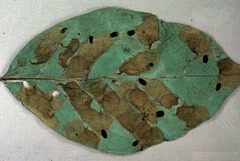
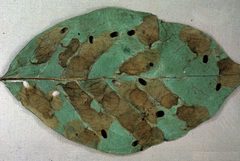
Antispila nysaefoliella is a leafmining in the Heliozelidae. Larvae feed exclusively on black tupelo (Nyssa sylvatica), creating mines in leaves. The is notable for producing distinct seismic signals during feeding and locomotion. are small with a wingspan of approximately 8 mm and are active in spring.
Pronunciation
How to pronounce Antispila nysaefoliella: /ænˈtɪspaɪlə ˌnaɪsiːəˌfɒliˈɛlə/
These audio files are automatically generated. While they are not always 100% accurate, they are a good starting point.
Identification
The small wingspan (approximately 8 mm) and association with black tupelo leaves are key identifying features. Larvae can be recognized by their leafmining habit on Nyssa sylvatica and the presence of sclerotized sound-producing structures on the dorsum and tail. The oval cutout shields characteristic of Heliozelidae leafmines may be present at the end of larval tunnels. Definitive identification may require examination of genitalia or .
Images
Appearance
are small with a wingspan of about 8 mm. Specific coloration and pattern details are not well documented in available sources. Larvae possess sclerotized structures on the dorsum and tail that are used to produce sound.
Habitat
Found in areas where black tupelo (Nyssa sylvatica) occurs. Larvae inhabit the leaves of their plant, feeding as leafminers within leaf tissue.
Distribution
Southeastern North America.
Seasonality
are on wing in spring. Larvae occur from late August to early September.
Diet
Larvae feed on leaf tissue of black tupelo (Nyssa sylvatica).
Host Associations
- Nyssa sylvatica - obligate larval black tupelo; larvae mine leaves
Life Cycle
Larvae feed as leafminers within black tupelo leaves. occurs within an oval cutout shield removed from the leaf mine, a characteristic of Heliozelidae. Specific details of -laying and longevity are not documented.
Behavior
Larvae produce three distinct seismic signals detectable as substrate-borne vibrations: chewing signals (short, high-amplitude bursts), scraping signals (longer, lower-amplitude continuous signals), and signals (regular, low-amplitude pulses). These seismic are produced by sclerotized structures on the larval dorsum and tail. The signals may serve communicative or defensive functions, though their exact adaptive significance remains to be fully determined. Larvae respond to vibrational stimuli with modified seismic behaviors.
Ecological Role
Leafminer that creates tunnels in leaves, potentially affecting leaf physiology. Larvae may serve as a food source for .
Similar Taxa
- Antispila treitschkiellaEuropean congeneric leafminer on Cornus ; distinguished by plant (cornelian cherry vs. black tupelo) and geographic range (Europe vs. North America)
- Antispila petryiEuropean congeneric leafminer on common dogwood (Cornus sanguinea); distinguished by plant and geographic range
More Details
Seismic Communication
This is one of the few documented leafmining insects with well-characterized seismic , making it a subject of interest for studies on substrate-borne vibration communication in Lepidoptera.
Sources and further reading
- BugGuide
- Wikipedia
- iNaturalist taxon
- NCBI Taxonomy
- Catalogue of Life
- Invasive moth overlooked in EU for decades | Blog
- Seismic Behaviors of a Leafminer, Antispila nysaefoliella (Lepidoptera: Heliozelidae)
- An Experimental Test of the Seismic Behaviors of Antispila Nysaefoliella (Lepidoptera: Heliozelidae) to Vibrational Stimuli