
Xyela bakeri
Konow, 1898
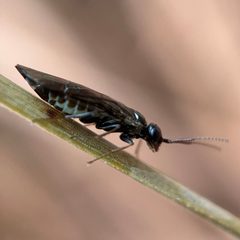
Xyela bakeri is a Nearctic in the Xyelidae, first described by Konow in 1898. It belongs to the X. bakeri species group, which includes the Japanese X. fusca and an undescribed Chinese species—one of only two Xyela groups with trans-Beringian distributions. The species is to North America with records spanning from Quebec to Florida and west to British Columbia, California, and the Yukon Territory. Larvae develop as internal feeders in pine cones, with documented including multiple Pinus species in subgenus Pinus.
Pronunciation
How to pronounce Xyela bakeri: //zaɪˈiːlə ˈbeɪkəɹi//
These audio files are automatically generated. While they are not always 100% accurate, they are a good starting point.
Identification
Member of the Xyela bakeri group distinguished by morphological and genetic affinities to East Asian relatives X. fusca and an undescribed Chinese species. are small typical of the Xyela. For precise diagnostic characters separating X. bakeri from other Nearctic Xyela species, keys to the genus should be consulted.
Images
Habitat
Pine forests; specifically associated with stands of Pinus that serve as larval .
Distribution
North America: Quebec to Florida, west to British Columbia and California. Northwestern records include Yukon Territory (Canada), with additional field observations from Colorado and California (USA).
Host Associations
- Pinus elliottii - larval slash pine
- Pinus palustris - larval slash pine
- Pinus ponderosa - larval ponderosa pine
- Pinus sabiniana - larval gray pine
- Pinus virginiana - larval Virginia pine
- Pinus contorta - larval additional based on northwestern records
Life Cycle
Larvae develop internally within pine cones of Pinus . Specific details of placement, larval instars, site, and timing are not documented in available sources.
Ecological Role
Larval feeding within pine cones suggests a role as a cone inhabitant; potential impact on seed development and cone integrity has not been quantified.
Similar Taxa
- Xyela fuscaClosely related Japanese in the same species group; distinguished by geography and association with P. (Strobus) parviflora rather than P. (Pinus) species
- Xyela julii groupSister clade to the X. bakeri group; Eurasian distribution with different associations
Sources and further reading
- BugGuide
- Wikipedia
- GBIF taxonomy match
- iNaturalist taxon
- NCBI Taxonomy
- Bembicid Holdings | Entomology Research Museum
- Encyrtid Holdings | Entomology Research Museum
- Two new species of yellow-shouldered bats endemic to the Neotropics | Blog
- Xyela fusca spec. nov. from Japan elucidates East Asian–North American relationships of Xyela (Hymenoptera, Xyelidae)