
Pleroneura
Konow, 1897
Species Guides
1- Pleroneura bruneicornis(Balsam Shootboring Sawfly)
Pleroneura is a of in the Xyelidae whose larvae are bud miners and shoot borers of fir (Abies) and spruce (Picea) . Larvae feed within developing buds and shoots of conifers, with multiple species sometimes co-occurring on the same tree. The genus occurs primarily in North America and Asia, with documented species attacking white fir in California, balsam fir in eastern North America, and Sakhalin spruce in Japan. Species-level remains problematic, with recognition not currently based on fundamental characters.
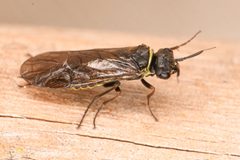
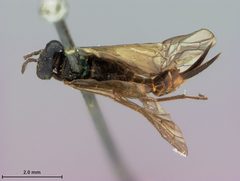
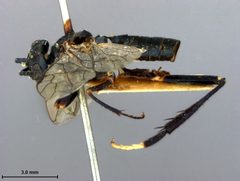
Pronunciation
How to pronounce Pleroneura: /ˌplɛroʊˈnʊrə/
These audio files are automatically generated. While they are not always 100% accurate, they are a good starting point.
Identification
distinguishable by genitalia; larvae of different cannot be separated morphologically. First instar larvae of each species mine buds in characteristic patterns specific to species, though later instar is not distinguishable. Species exhibit different ovipositional postures and oviposit in different parts of the bud.
Images
Habitat
Coniferous forests containing fir (Abies) or spruce (Picea) trees. Larvae occur within tree crowns, concentrated in the outer half and middle third of the crown. rates increase from bottom to top of crown and decrease as tree size increases.
Distribution
North America and Asia. Documented from: central Sierra Nevada of California (white fir); New Brunswick, eastern Nova Scotia, upper peninsula of Michigan, northern Wisconsin, and New York (balsam fir); Japan (Sakhalin spruce).
Diet
Larvae feed on active buds and shoots of conifers. Documented include Abies concolor (white fir), Abies balsamea (balsam fir), and Picea glehnii (Sakhalin spruce).
Host Associations
- Abies concolor - larval white fir; three Pleroneura studied in California
- Abies balsamea - larval balsam fir; P. borealis
- Picea glehnii - larval Sakhalin spruce; P. piceae
Life Cycle
oviposited in buds. First instar larvae mine buds in -specific patterns; later instar larval not distinguishable between species. and details not specified in available sources.
Behavior
Bud mining and shoot boring; larvae feed within developing buds and shoots. Multiple may occupy same tree and same without apparent competition at moderate levels. Larvae show vertical stratification within tree crowns, with higher rates toward crown top.
Ecological Role
Herbivore of conifer buds and shoots. At moderate levels, feeding appears to have little if any effect on tree growth.
Human Relevance
Occasional pest of conifer plantations and forests; larval injury to shoots can be locally common. P. borealis caused notable injury to balsam fir shoots in New Brunswick in 1945.
Similar Taxa
- Other Xyelidae generaPleroneura distinguished by bud mining/shoot boring habit on Abies and Picea; other xyelids may have different associations or feeding habits
- Other conifer-feeding sawfly generaPleroneura specifically targets buds and shoots rather than needles or foliage of other groups
More Details
Taxonomic uncertainty
recognition in the is not at present based upon fundamental characters per Ross (cited in Felt 1951). This limits confident identification and may affect biological interpretations attributed to specific species.
Niche partitioning
Three sympatric Pleroneura on white fir in California occupy the same without apparent competition at moderate densities, suggesting resource partitioning through oviposition site selection within buds.
Sources and further reading
- BugGuide
- GBIF taxonomy match
- iNaturalist taxon
- NCBI Taxonomy
- Catalogue of Life
- Notes on the Biology of Pleroneura borealis Felt (Xyelidae: Hymenoptera)
- Inter‐tree variation and yearly fluctuation in the susceptibility of Sakhalin spruce Picea glehnii, to shoot‐boring sawfly Pleroneura piceae
- BIOLOGICAL STUDIES OF BUD MINING SAWFLIES, PLERONEURA SPP. (HYMENOPTERA: XYELIDAE), ON WHITE FIR IN THE CENTRAL SIERRA NEVADA OF CALIFORNIA: II. LARVAL DISTRIBUTION WITHIN TREE CROWNS
- BIOLOGICAL STUDIES OF BUD MINING SAWFLIES, PLERONEURA SPP. (HYMENOPTERA: XYELIDAE), ON WHITE FIR IN THE CENTRAL SIERRA NEVADA OF CALIFORNIA: I. LIFE CYCLES, NICHE UTILIZATION, AND INTERACTION BETWEEN LARVAL FEEDING AND TREE GROWTH