
Megaxyela major
(Cresson, 1880)
Megaxyela major is a of in the Xyelidae, one of the most primitive families of Hymenoptera. The Megaxyela contains some of the largest xyelid sawflies. Species in this genus are associated with walnut (Juglans) and hickory (Carya) trees as for their larvae.
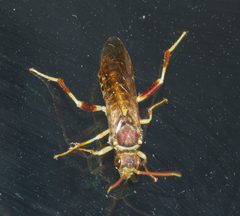
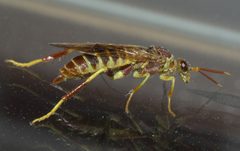
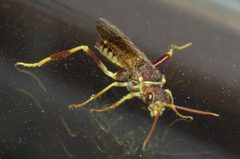
Pronunciation
How to pronounce Megaxyela major: /ˌmɛɡəˈzaɪələ ˈmeɪdʒər/
These audio files are automatically generated. While they are not always 100% accurate, they are a good starting point.
Images
Distribution
North America. The Megaxyela is primarily Nearctic in distribution.
Diet
Larvae feed internally in buds and shoots of walnut (Juglans) and hickory (Carya) . have been observed feeding on pollen.
Host Associations
- Juglans - larval walnut
- Carya - larval hickory
Ecological Role
As primary consumers of walnut and hickory tissues, larvae may influence bud development and shoot growth in trees. The Xyelidae represents an early evolutionary lineage of Hymenoptera, making like M. major of interest for studies of hymenopteran and the evolution of plant-feeding in the order.
Similar Taxa
- Megaxyela langstoniAnother large in the same , also associated with Juglans; distinguished by morphological details of and genitalia
- PleroneuraAnother xyelid with larvae in conifer buds; distinguished by association (conifers vs. hardwoods) and
More Details
Taxonomic significance
Megaxyela major belongs to Xyelidae, the only extant in the suborder that retains the ancestral condition of a mobile last tergite and ovipositor, characteristics of the earliest Hymenoptera.
Collection records
The has been documented in entomological collections, with specimens deposited in institutions including the Bohart Museum of Entomology at UC Davis.
Sources and further reading
- BugGuide
- GBIF taxonomy match
- iNaturalist taxon
- NCBI Taxonomy
- UC Davis Animal Science Major Ivana Satre Vying for Miss Vietnam Northern California Title | Bug Squad
- Geoffrey Attardo: Growing Presence of This Mosquito: 'A Major Public Health Threat' | Bug Squad
- Meet Andrea Guggenbickler, Outstanding Academic Advisor | Bug Squad
- Marek Borowiec's Awesome Social Insects Award | Bug Squad
- Top Notch Advisors: Elvira Galvan Hack and Robert Kimsey | Bug Squad
- Name That Bug! What About Bob? | Bug Squad