
Parancistrocerus bicornis
(Roberts, 1901)
Species Guides
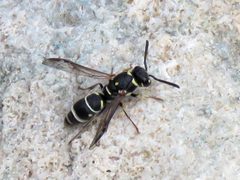
2Parancistrocerus bicornis is a small mason wasp in the Eumeninae, described by Roberts in 1901. Like other members of the , it is a solitary, cavity-nesting that provisions its nests with paralyzed caterpillars as food for its larvae. The is part of a taxonomically challenging group where live specimens and even microscope examination often cannot reliably distinguish between closely related species such as Parancistrocerus and Stenodynerus.
Pronunciation
How to pronounce Parancistrocerus bicornis: //ˌpæɹ.ənˌsɪs.trəˈsiːɹ.əs baɪˈkɔːr.nɪs//
These audio files are automatically generated. While they are not always 100% accurate, they are a good starting point.
Identification
Parancistrocerus bicornis is extremely difficult to distinguish from Stenodynerus and other Parancistrocerus based on images of live specimens. Even with actual specimens under a microscope, identification is challenging. The Parancistrocerus generally comprises small mason wasps with patterning, but species-level identification typically requires expert examination and may not be possible from photographs alone.
Images
Habitat
Nests in pre-existing cavities such as hollow twigs, old borings in dead wood, or artificial blocks. Requires standing deadwood or pithy stems in sunny, sheltered locations with nearby floral resources.
Diet
nectar on flowers. Larvae feed on paralyzed caterpillars provisioned by the female parent.
Life Cycle
Females use pre-existing tunnels, dividing them into multiple constructed from the bottom up. Each cell is provisioned with paralyzed caterpillars, then sealed with a partition of sand glued together with saliva. A single is laid on the last caterpillar in each cell. Development occurs within the sealed cells, with offspring emerging to repeat the cycle.
Behavior
Solitary and non-aggressive, lacking social colony structure. Females hunt caterpillars, paralyze them with their sting, and stock them in nest . have been observed visiting flowers for nectar.
Ecological Role
of caterpillars, particularly in the Coleophoridae and Tortricidae based on congeneric . Contributes to pollination through nectar-feeding. Provides nest cavities for subsequent use by other cavity-nesting insects after abandonment.
Human Relevance
Beneficial for garden through caterpillar and incidental pollination. Can be attracted to gardens through provision of blocks or bundled hollow twigs (such as sumac) in south-facing sheltered locations. Poses minimal sting risk due to solitary, non-defensive nature.
Similar Taxa
- Stenodynerus spp.Extremely similar ; cannot be reliably distinguished from Parancistrocerus bicornis in images of live specimens or even with microscope examination in most cases.
- Parancistrocerus perennisCongeneric with similar size (wing length 6-8 mm), nesting , and appearance; distinguished by geographic range and subtle morphological features requiring expert identification.