
Monobia texana
(Cresson, 1872)
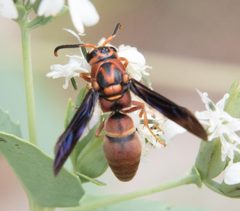
Monobia texana is a solitary mason wasp in the Vespidae, Eumeninae. The occurs in Arizona and Texas, distinct from the more widespread eastern species Monobia quadridens. Like other mason wasps, females utilize pre-existing cavities in wood or other materials as nesting sites, provisioning them with paralyzed caterpillars for their larvae. The species has been documented in iNaturalist observations but detailed biological studies specific to this species are limited.
Pronunciation
How to pronounce Monobia texana: /məˈnoʊ.bi.ə tɛkˈsæ.nə/
These audio files are automatically generated. While they are not always 100% accurate, they are a good starting point.
Identification
Monobia texana can be distinguished from the similar Monobia quadridens by geographic range: M. texana occurs in Arizona and Texas, while M. quadridens ranges across the eastern United States. Both share the -level traits of black and white coloration typical of Monobia. Males of M. quadridens have a white (facial marking), while females have entirely black ; this may apply to M. texana but has not been explicitly documented. The specific epithet "texana" reflects the type locality in Texas.
Images
Habitat
Occurs in Arizona and Texas, where suitable nesting cavities are available. Based on congeneric , likely utilizes abandoned tunnels, hollow stems, or other pre-existing cavities in wood or similar substrates.
Distribution
Arizona and Texas, United States. The is with Monobia quadridens, which occupies the eastern United States.
Similar Taxa
- Monobia quadridensClosely related with overlapping but distinct geographic range; M. quadridens occurs in eastern North America from southern Ontario to Kansas, New Mexico, and Wisconsin, plus northern Mexico, while M. texana is restricted to Arizona and Texas
Sources and further reading
- BugGuide
- GBIF taxonomy match
- iNaturalist taxon
- Catalogue of Life
- Grasshoppers of Colorado
- Bug Eric: Wasp Wednesday: Four-toothed Mason Wasp
- Humans help wasps, wasps help humans: Four-toothed mason wasp, Monobia quadridens — Bug of the Week
- Watch out monarda munchers, a wicked wasp is coming to get you: Four-toothed mason wasp, Monobia quadridens — Bug of the Week
- On the prowl to paralyze pests here in the DMV: Four-toothed mason wasps, Monobia quadridens — Bug of the Week
- Bug Eric: The Wasp Wall