
Eumenes crucifera
Provancher, 1888
Cross Potter Wasp
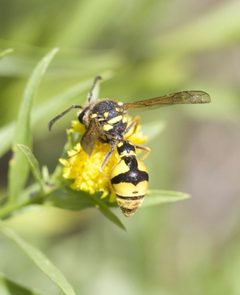
Eumenes crucifera, commonly known as the cross potter wasp, is a North American potter wasp in the Vespidae. This solitary constructs distinctive urn-shaped mud nests, often described as resembling small clay pots with fluted necks. The exhibits considerable variation in coloration, which historically led to the recognition of four ; however, taxonomic revisions in 2018 consolidated most of these, elevating only Eumenes flavitinctus to full species status while upmerging the remaining three back into E. crucifera. The species occurs across Canada, the United States, and Mexico.
Pronunciation
How to pronounce Eumenes crucifera: /ˈjuːmɪˌniːz kruːˈsɪfərə/
These audio files are automatically generated. While they are not always 100% accurate, they are a good starting point.
Identification
The urn-shaped mud nest is the most reliable field characteristic for identifying this . Nests are constructed entirely of mud, approximately marble-sized, and feature a distinctive fluted neck. The itself may be identified by its potter wasp , though specific markings vary due to the species' documented color . Final identification may require examination of nest architecture in combination with geographic location.
Images
Appearance
exhibit notable phenotypic variation, particularly in coloration. As a member of the Eumenes, individuals possess the characteristic thread-waisted body form typical of potter wasps, with a narrow petiole connecting the and . The specific epithet 'crucifera' likely refers to a cross-like marking pattern, though precise coloration varies among individuals and .
Habitat
Found in diverse environments across its broad North American range. Nests are typically constructed in sheltered locations such as recessed window frames, tree hollows, or attached to vegetation including pine needles. The shows adaptability in nest site selection, with documented occurrences on both natural substrates and human-associated structures.
Distribution
Occurs throughout North America, with confirmed records from Canada, the United States, and Mexico. GBIF distribution records specifically document the from Vermont and other U.S. locations.
Seasonality
activity and nest construction occur during the warmer months. Based on related Eumenes and general potter wasp , females likely construct nests in spring and summer, with offspring emerging the same season or following spring if pupae overwinter.
Diet
feed on nectar. Females provision nests with paralyzed caterpillars as food for their developing larvae.
Life Cycle
Females construct a complete mud urn before hunting. They capture and paralyze several small caterpillars, stock the pot with this prey, lay a single inside, and seal the top with a mud plug. The larva hatches to find fresh paralyzed food, consumes the provisions, pupates within the pot, and emerges as an through a hole chewed in the side of the nest. Some individuals may overwinter as pupae.
Behavior
Solitary nesting with no cooperative colony structure. Females exhibit precise mud-working behavior, using to shape and smooth mud boluses collected from soil and water sources. Nest construction is completed before provisioning begins. are not aggressive and do not defend nests actively.
Ecological Role
As a of caterpillars, this contributes to natural pest control. The larval provisioning helps regulate lepidopteran . may function as flower visitors, though their role as is likely incidental rather than significant.
Human Relevance
Generally beneficial due to caterpillar . Nests are sometimes considered aesthetically interesting but may be removed by homeowners unaware of their harmlessness. The poses minimal stinging risk as solitary are non-aggressive and females will flee rather than attack when disturbed.
Similar Taxa
- Eumenes flavitinctusFormerly treated as a of E. crucifera but elevated to full status in 2018. Previously distinguished by coloration differences now recognized as species-level divergence.
- Sceliphron caementariumBlack and yellow mud dauber also constructs mud nests, but builds multi-celled clod-like structures rather than discrete urn-shaped pots. Belongs to Sphecidae rather than Vespidae.
- Trypoxylon politumPipe organ mud dauber constructs linear mud tube nests with multiple internal , superficially similar material but architecturally distinct from Eumenes urns.
More Details
Taxonomic History
The ' variable coloration historically complicated . Four were recognized until 2018, when revisions elevated Eumenes flavitinctus to species rank and synonymized the remaining three subspecies with E. crucifera.
Nest Architecture
The 'potter wasp' directly references the remarkable resemblance between Eumenes nests and human-crafted pottery vessels. Some sources suggest Native American pottery designs may have been inspired by these natural structures, though this hypothesis requires further verification.
Sources and further reading
- BugGuide
- Wikipedia
- GBIF taxonomy match
- iNaturalist taxon
- NCBI Taxonomy
- Catalogue of Life
- Bug Eric: Mud Masterpieces
- Bug Eric: January 2010
- Bug Eric: Bee Flies
- Bug Eric: Spider Sunday: Hentz's Orbweaver
- Bug Eric: Wasp Wednesday: Walden's Mason Wasp, Ancistrocerus waldenii
- 🪲 Entomologizing w/ the WGNSS Entomology Group at Hughes Mountain Natural Area — 11 Oct 2025 | Beetles In The Bush