
Methocha stygia
(Say, 1823)
ant-like wasp, tiger beetle parasitoid wasp
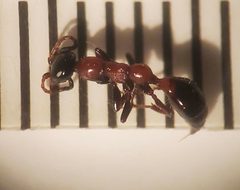
Methocha stygia is a specialized in the Tiphiidae that exhibits remarkable -mimicry (myrmecomorphy) in both and . This targets tiger larvae () as its exclusive , employing a distinctive hunting strategy where females aggressively engage their prey and deliberately allow themselves to be grasped by the larva's sickle-shaped to gain entry to the burrow. The wasp's ant-like appearance enables it to approach host burrows without triggering the defensive responses that tiger beetle larvae typically direct against conventional wasp .
Pronunciation
How to pronounce Methocha stygia: //mɛˈθoʊ.kə ˈstɪ.dʒi.ə//
These audio files are automatically generated. While they are not always 100% accurate, they are a good starting point.
Identification
Superficially resembles Pseudomyrmex ants in general form; slender body with -like waist retained. Distinguished from actual ants by presence of wings in females (ants are wingless except for reproductive ), and by the single pair of wings characteristic of Hymenoptera versus the two pairs in other winged insects. Males are more commonly collected in and differ from females in ; females are rarely encountered due to their specialized ground-foraging .
Images
Habitat
Open, sandy areas where tiger larvae construct burrows; typically found in sandy creek beds and along receding bodies of water where tiger beetle are abundant.
Seasonality
females are highly seasonal and active primarily during periods when tiger larvae are accessible in their burrows; reported as rare most of the year with peak activity in summer months. Males are more frequently encountered throughout the season due to their attraction to .
Host Associations
- tiger beetle larvae (Cicindelidae) - Exclusive ; females paralyze larvae with sting and oviposit on immobilized host
Life Cycle
Females locate tiger larval burrows and engage in aggressive predatory to access the . The paralyzes the larva with its sting, then deposits an on the immobilized host. The wasp larva develops as an ectoparasitoid on the paralyzed tiger beetle larva, eventually consuming it and emerging as an .
Behavior
Exhibits specialized -mimicry (myrmecomorphy) in both and movement, which deceives tiger larvae into perceiving the as an ant rather than a threat. Unlike other that sneakily deposit near burrows, Methocha females actively engage their prey and deliberately allow themselves to be grasped within the larva's sickle-shaped to gain entry to the burrow. The sting is reported as mild and usually does not pierce human skin.
Ecological Role
Acts as a regulator of tiger beetles; represents a significant on tiger defensive and burrow-guarding strategies. The specialized -mimicry suggests evolutionary arms race dynamics between and prey.
Human Relevance
Of interest to entomologists studying - and mimicry systems; specimens are actively sought by researchers revising the . The is poorly represented in collections due to the difficulty of encountering females in the field.
Similar Taxa
- Methocha (other species) is taxonomically incompletely known with several new recently discovered in Texas; identification to species level requires examination
- Pseudomyrmex antsSuperficial morphological resemblance due to convergent myrmecomorphy; distinguished by wing structure, , and ecological context
Sources and further reading
- BugGuide
- GBIF taxonomy match
- iNaturalist taxon
- ID Challenge #11 | Beetles In The Bush
- Spooky eyes on the Stygian rainforest floor: Headlight beetles, fire beetles, Pyrophorus spp. — Bug of the Week
- Cicindelidae | Beetles In The Bush | Page 9
- Hymenoptera | Beetles In The Bush | Page 7
- Working with Cerceris fumipennis—Epilogue | Beetles In The Bush
- parasitic wasps | Beetles In The Bush
- Predatory behaviour in the ant-like wasp Methocha stygia (Say) (Hymenoptera: Tiphiidae)