
Nematus latitarsus
dusky birch sawfly
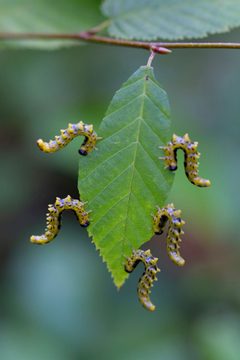
Nematus latitarsus, commonly known as the dusky birch , is a sawfly in the Tenthredinidae. The larvae feed on birch leaves, often stripping foliage to the midvein. When disturbed, larvae display a distinctive group defensive , arching their backs and curling their into an "S" shape. The species is associated with river birch and other birch species. are small -like insects with a saw-like ovipositor used to insert into leaf tissue.
Pronunciation
How to pronounce Nematus latitarsus: /nɛ.mə.təs læ.tɪˈtɑːr.səs/
These audio files are automatically generated. While they are not always 100% accurate, they are a good starting point.
Identification
Larvae resemble caterpillars but can be distinguished by having six or more pairs of (/ caterpillars typically have five or fewer) and the absence of on prolegs. The distinctive "S"-shaped defensive posture when disturbed, with arched back and curled , helps separate this from caterpillars. On birch, gregarious feeding damage with larvae present distinguishes it from solitary feeders.
Images
Appearance
Larvae are caterpillar-like with slender bodies, distinct , and six or more pairs of fleshy on abdominal segments. Unlike and caterpillars, larvae lack (small hook-like structures) on their prolegs. are small, -like insects with a saw-shaped ovipositor on the .
Habitat
Associated with birch trees, particularly river birch. Found in gardens, landscapes, and natural areas where birch occur.
Distribution
North America; presence documented in regions where river birch and other birch grow.
Seasonality
Active during summer and autumn. Larval feeding occurs in late season, with first frost typically ending activity.
Diet
Larvae feed on birch leaves, often consuming foliage down to the midvein. River birch is a documented .
Host Associations
- Betula nigra - larval food plantriver birch
Life Cycle
Females use their saw-like ovipositor to slit leaf surfaces and insert into leaf tissue. Eggs hatch into larvae that feed on leaves. Mature larvae bore into twigs to pupate. emerge from pupae.
Behavior
Larvae are gregarious and feed in groups. When harassed by or disturbed, larvae collectively arch their backs and curl their into an "S" posture; this has been reported as a defensive display.
Ecological Role
Herbivore that consumes birch foliage. Serves as prey for , with defensive posturing suggesting predator-prey interactions.
Human Relevance
Considered a garden and landscape pest on birch trees, though late-season damage is often cosmetic rather than harmful to tree health. Control is generally not recommended as deciduous trees have completed most growth by late season when damage occurs.
Similar Taxa
- Allantus cinctusSimilar with caterpillar-like larvae, but feeds on roses rather than birch and displays curled resting posture rather than "S"-shaped defensive posture.
- Lepidoptera larvae (caterpillars)Similar larval appearance, but distinguished by fewer (typically five or fewer pairs), presence of on prolegs, and different defensive .
More Details
Taxonomic note
The has been referred to as Croesus latitarsus in some sources; Nematus latitarsus is the currently accepted name on iNaturalist and reflects taxonomic revisions within the Tenthredinidae.