
Hemichroa crocea
(Geoffroy, 1785)
striped alder sawfly, banded alder sawfly
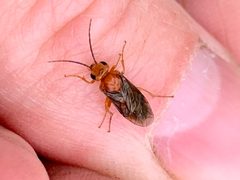
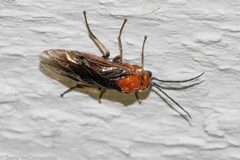
Hemichroa crocea is a in the Tenthredinidae, commonly known as the striped alder sawfly or banded alder sawfly. The species is likely native to Europe and has been introduced to North America, where it is actively expanding its range. It is notable for having two per year and for the gregarious feeding of its larval stage on alder foliage.
Pronunciation
How to pronounce Hemichroa crocea: /hɛˈmɪkroʊə ˈkroʊsiə/
These audio files are automatically generated. While they are not always 100% accurate, they are a good starting point.
Identification
can be recognized by the distinctive orange-red contrasting with the black . Larvae are distinguished from caterpillars by having more than five pairs of (a trait of ), and by the specific pattern of dark brown stripes and lateral markings on a yellowish background. The gregarious feeding habit of larvae—consuming entire leaves except midrib and —is a behavioral indicator.
Images
Habitat
Associated with riparian and wetland where alders (Alnus spp.) occur. Larvae are found on the foliage of host trees; overwinter in thin-walled cocoons in soil or sand.
Distribution
Probably native to Europe; established in North America including southern Canada (British Columbia, Manitoba) and northern United States, with ongoing range expansion across the continent. Documented in Belgium.
Seasonality
First active in late May; larvae present through July. Second generation adults appear in late July and August, with larvae present August through September. Prepupal stage overwinters in soil.
Diet
Larvae feed on foliage of alder (Alnus glutinosa, A. incana, A. viridis), and have been observed on silver birch (Betula pendula), hazel (Corylus avellana), and willow (Salix spp.). do not feed.
Host Associations
- Alnus glutinosa - larval food plantcommon alder
- Alnus incana - larval food plantgrey alder
- Alnus viridis - larval food plantgreen alder
- Betula pendula - larval food plantsilver birch
- Corylus avellana - larval food planthazel
- Salix - larval food plantwillow
Life Cycle
(two per year). are laid in slits beside leaf midribs. Larvae are gregarious, feeding together and skeletonizing leaves. First generation larvae reach full size in July, descend to ground, and overwinter as in thin-walled cocoons constructed from sand and soil particles. Second generation larvae complete development in August–September and also overwinter as prepupae.
Behavior
Larvae exhibit gregarious feeding , consuming entire leaves except for the midrib and major before moving to adjacent leaves. construct thin-walled cocoons using sand and soil particles cemented together.
Ecological Role
Herbivore that can cause defoliation of alder and related woody plants. The gregarious larval feeding can result in noticeable leaf damage in localized areas.
Human Relevance
Minor pest of ornamental alders and related trees; defoliation is generally not severe enough to cause significant economic or ecological damage. Presence indicates healthy stands of plants.
Similar Taxa
- Other Hemichroa speciesCongeneric may share similar associations and larval ; precise identification requires examination of coloration and genitalia.
- Caterpillars of Lepidoptera on AlnusLarvae resemble caterpillars but possess more than five pairs of and lack (hooked structures) on prolegs; are clearly -like rather than -like.
More Details
Taxonomic note
Authority sometimes cited as (Fourcroy, 1785) or (Geoffroy, 1785); Geoffroy is the accepted authority in modern usage.
Introduction history
The has been introduced to North America from Europe, though the timing and mechanism of introduction are not well documented. Range expansion is ongoing.