
Eupareophora
Enslin, 1914
spiny ash sawflies
Species Guides
1- Eupareophora parca(Spiny Ash Sawfly)
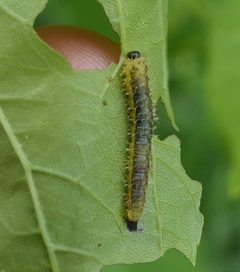
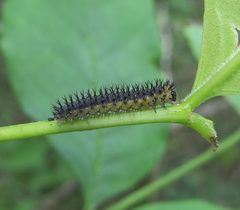
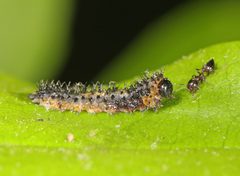
Eupareophora is a of in the Tenthredinidae, Blennocampinae. The genus contains at least two : the West Palaearctic E. exarmata and the Nearctic E. parca. Both species are associated with ash trees (Fraxinus spp.) as . Larvae are characterized by prominent spines and can cause significant defoliation. E. parca has shown rapid increases in urban settings, suggesting potential as an urban pest.
Pronunciation
How to pronounce Eupareophora: //juːˌpæriˈɒfərə//
These audio files are automatically generated. While they are not always 100% accurate, they are a good starting point.
Identification
Larvae distinguished by prominent body spines and association with ash trees. E. exarmata can be distinguished from E. parca by molecular analysis (COI sequence divergence of 10.8%) and geographic distribution. require identification within Blennocampinae.
Images
Habitat
Deciduous forest and urban or park settings with ash trees. Larvae of E. exarmata found on tree trunks 30-120 cm above soil level.
Distribution
West Palaearctic (E. exarmata: southern Sweden to Spain, east to Caucasus) and Nearctic (E. parca: North America, including Alberta, Canada). GBIF records indicate presence in Denmark, Norway, and Sweden.
Seasonality
E. exarmata: fly soon after bud-break in spring; larvae develop from late April to early June. E. parca: adult period in spring, with larval development following.
Diet
Folivore; larvae feed on foliage of Fraxinus (ash trees).
Host Associations
- Fraxinus excelsior - Primary for E. exarmata in Germany and Georgia
- Fraxinus spp. - for E. parca in North America
Life Cycle
. emerge in spring soon after bud-break. Larvae develop through multiple instars, with mature larvae crawling down trunks to complete development. Overwinters as mature larva or in formed in bark.
Behavior
Mature larvae crawl down tree trunks to locate sites for completing development. Larvae may form in bark. Rapid increases have been observed in E. parca, with significant expansion in defoliation extent between successive years.
Ecological Role
Defoliator of ash trees. E. parca has been identified as an occasional pest in planted ash stands and shows potential to become a significant urban pest.
Human Relevance
E. parca represents a potential urban pest threat to cultivated ash trees, with documented rapid increase and expanding defoliation in Edmonton, Alberta. E. exarmata is rarely recorded and not considered a significant pest.
Similar Taxa
- Other Blennocampinae sawfliesSimilar ; distinguished by association with Fraxinus and larval spine characteristics
- Eupareophora exarmata / E. parcaThe two within the ; distinguished by geographic distribution (West Palaearctic vs. Nearctic) and molecular divergence
Misconceptions
Earlier records of E. exarmata on Rosa are considered erroneous based on probable misidentification; the confirmed host is Fraxinus excelsior.
More Details
Molecular confirmation
COI sequence analysis (1078 ) confirms placement within Tenthredinidae, with E. exarmata and E. parca as closest relatives showing 10.8% sequence divergence.
Spine regeneration
Spines are absent on freshly moulted larvae but reappear within one day, based on observations of E. exarmata in Georgia.