
Athalia
Leach, 1817
Tigress Sawflies
Species Guides
1- Athalia cornubiae(Stonecrop Tigress)
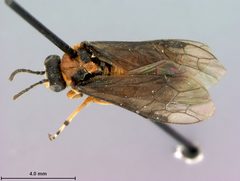
Athalia is a of in the Tenthredinidae, commonly known as Tigress Sawflies. occur across Eurasia, Africa, and North America. Several species are economically significant pests of cruciferous crops, with specialized associations and distinct strategies including adaptations.

Pronunciation
How to pronounce Athalia: /əˈθeɪliə/
These audio files are automatically generated. While they are not always 100% accurate, they are a good starting point.
Identification
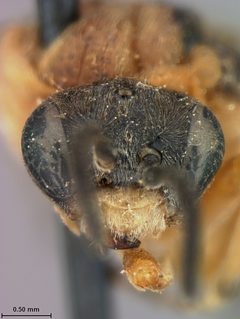
Distinguished from other by combination of: small to medium size, often with bold yellow and black coloration; larvae feed externally on leaves rather than mining or gall-forming; lack the narrow waist characteristic of many other Hymenoptera. -level identification requires examination of genitalia and wing venation patterns.
Images
Habitat
Associated with plants of Brassicaceae (crucifers) for most economically important ; some species occupy cool, shady where specific host plants such as Cardamine grow.
Distribution
Eurasia, Africa, and North America. Specific records include Japan for A. japonica, A. rosae rosae, and A. rosae ruficornis; Chengde, Hebei Province, China (40°59′36″ N, 117°24′2″ E) for Dentathalia scutellariae; Sweden and Poland from GBIF occurrence data.
Seasonality
A. japonica exhibits spring and autumn activity periods with summer ; A. rosae and A. infumata maintain 5–6 annually without summer diapause, remaining active through summer months.
Diet
Larvae feed on cruciferous plants (Brassicaceae). Specific documented include: cultivated crucifers (Brassica spp., Raphanus spp.); wild crucifers including Cardamine (primarily for A. japonica) and Rorippa indica (for A. infumata); Scutellaria baicalensis (Lamiaceae) for Dentathalia scutellariae where larvae consume fruit pods and seeds.
Host Associations
- Brassicaceae - primary larval cultivated and wild crucifers used by multiple Athalia
- Cardamine - primary spring and autumn sprouting matches A. japonica
- Rorippa indica - primary year-round new leaf production supports A. infumata
- Scutellaria baicalensis - Lamiaceae; exclusive for Dentathalia scutellariae larvae on fruit pods and seeds
Life Cycle
Varies by : A. japonica is with obligate summer as ; A. rosae rosae and A. rosae ruficornis are multivoltine with 5–6 annually and no summer diapause. All species oviposit on young leaves only. Thermal threshold for development lower in A. japonica than in .
Behavior
A. japonica enters summer in response to long spring daylengths as temporal avoidance of pressure; employ rapid development and spatial selection as alternative strategies. Larvae are external feeders causing defoliation; D. scutellariae larvae cause pod emptying and seed loss.
Ecological Role
Herbivore on Brassicaceae and other plants; serves as host for specialized including Oomyzus sokolowskii (Braconidae). Coexistence of sympatric demonstrates temporal and spatial partitioning mediated by parasitoid avoidance. D. scutellariae acts as significant agricultural pest of medicinal plant .
Human Relevance
Major pest of cruciferous vegetable crops including turnips, radishes, and related Brassicaceae. D. scutellariae causes significant economic damage to Scutellaria baicalensis (Chinese skullcap), a medicinal plant of commercial importance. Subject of genomic research for developing targeted control strategies.
Similar Taxa
- DentathaliaFormerly included in Athalia; separated based on morphological and genomic differences; D. scutellariae specialized on Lamiaceae rather than Brassicaceae
- Other Tenthredinidae generaAthalia distinguished by external leaf-feeding larvae, coloration patterns, and specific associations with crucifers
More Details
Taxonomic Note
placement varies: Tenthredinidae per iNaturalist and GBIF; Athaliidae per NCBI . Dentathalia scutellariae has been transferred to separate based on de novo assembly and specialization.
Evolutionary Significance
Sympatric Athalia in Japan demonstrate divergent adaptive strategies for coping with shared natural enemies: temporal escape via versus spatial escape via rapid development and continuous breeding.
Sources and further reading
- BugGuide
- Wikipedia
- GBIF taxonomy match
- iNaturalist taxon
- NCBI Taxonomy
- Catalogue of Life
- Why does only Athalia Japonica enter summer diapause among three sympatric Athalia sawflies feeding on crucifers?
- De Novo Genome Assembly, Genomic Features, and Comparative Analysis of the Sawfly Dentathalia scutellariae.