
Urocerus albicornis
(Fabricius, 1781)
white-horned horntail, black horntail sawfly
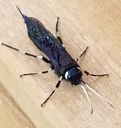
Urocerus albicornis is a large woodwasp native to North America, characterized by black body coloration with whitish , lateral spots, and two pale bands on each leg. The has established introduced in northern Spain and has been recorded in Japan and possibly southern France. are active from late June through September, with peak in August–September. Females possess a prominent ovipositor used to deposit into sapwood of conifer trees, accompanied by symbiotic white-rot fungi that enable larval development.
Pronunciation
How to pronounce Urocerus albicornis: /ˌjʊərəˈsɪrəs ˌælbiˈkɔrnɪs/
These audio files are automatically generated. While they are not always 100% accurate, they are a good starting point.
Identification
Distinguished from other Siricidae by the combination of black body with whitish , paired pale spots on either side of the , and two distinct pale bands on each leg. The name 'albicornis' refers to the pale antennae. Similar to Urocerus gigas but differs in antennal coloration and leg banding pattern. Females are larger than males and possess a long, conspicuous ovipositor.
Images
Habitat
Coniferous forests; specifically associated with stumps, fallen timber, and weakened or stressed trees of Pinaceae and Cupressaceae. All stages develop within sapwood.
Distribution
Native to Canada and the continental United States. Introduced and established in northern Spain (Basque Country, confirmed 2011–2012); recorded from Japan (one specimen) and probably established in southern France (two specimens). Climatic suitability exists for potential establishment in additional EU member states.
Seasonality
fly from late June to September, with peak activity in August–September in Spain. period corresponds to warm summer months in native range.
Diet
Larvae feed on wood infected by symbiotic white-rot fungi Amylostereum chailletii or A. areolatum; the fungi function as an external rumen, breaking down cellulose to enable larval digestion. feeding habits are not well documented.
Life Cycle
Lifecycle lasts approximately 2 years in British Columbia. Females deposit into sapwood together with mucus containing venom and symbiotic white-rot fungus. All stages (egg, larva, pupa) occur within sapwood. takes place in wood, with emerging through exit holes.
Behavior
are attracted to α-pinene, β-pinene, and ethanol. Females use a long ovipositor to drill into wood and deposit with associated symbiotic fungi. Non-venomous and non-aggressive; the apparent 'stinger' is the ovipositor.
Ecological Role
Contributes to wood decomposition through fungal decay and larval tunneling; acts as a wood-decay agent in forest . Impairs structural integrity of wood through gallery formation. Serves as host for including giant ichneumons (Megarhyssa spp.) and ibaliid wasps (Ibalia spp.).
Human Relevance
Not considered a pest in native range where it primarily attacks stressed, dying, or dead trees. Can impair wood quality through fungal staining and larval galleries. Potential to be transported in conifer wood, solid wood packaging material, or plants for planting. Subject to phytosanitary concern in Europe due to established .
Similar Taxa
- Urocerus gigasPalearctic with similar and ; U. albicornis distinguished by whitish and leg banding pattern
- Tremex columbaNative North American horntail of similar size, but attacks hardwoods rather than conifers and lacks pale antennal coloration
- Sirex noctilioAnother introduced siricid in Europe, but differs in having a metallic blue-black body and different fungal
Sources and further reading
- BugGuide
- Wikipedia
- GBIF taxonomy match
- iNaturalist taxon
- NCBI Taxonomy
- Encyrtid Holdings | Entomology Research Museum
- Bug Eric: Wasp Wednesday: Pigeon Tremex Horntail
- Composición de especies y periodo de vuelo de las avispas de la madera (Hymenoptera: Siricidae) en los bosques de coníferas del País Vasco, con la confirmación del asentamiento de la especie exótica Urocerus albicornis (Fabricius, 1781) en el norte de España
- Pest categorisation of Urocerus albicornis.