
Sirex cyaneus
Fabricius, 1781
blue horntail
Sirex cyaneus, commonly known as the blue horntail, is a of woodwasp in the Siricidae. Native to forests in Alberta, Canada, reach approximately 2 cm in length. The species serves as a for including Rhyssa persuasoria and Ibalia leucospoides, which have been studied for potential applications.
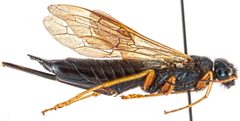
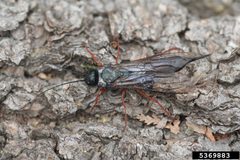
Pronunciation
How to pronounce Sirex cyaneus: //ˈsaɪ.rɛks saɪˈeɪ.ni.əs//
These audio files are automatically generated. While they are not always 100% accurate, they are a good starting point.
Images
Habitat
Forests in Alberta, Canada. Associated with coniferous trees; larvae bore into wood.
Distribution
Canada: Alberta, Labrador. Presence recorded in Austria (AT); doubtful record in Belgium (BE).
Host Associations
- Pinus radiata - not a direct ; related to contextSirex juvencus (now Sirex noctilio) is destructive to Pinus radiata plantations in New Zealand; of S. cyaneus were suggested for introduction there
- Larix europaea - associated with collection localityLarch trees present at Oxford locality where collections were made; not confirmed as direct for S. cyaneus
Life Cycle
Larvae bore into wood. Parasitized larvae make final just under and approximately parallel to bark surface when attacked by Ibalia leucospoides.
Behavior
Larvae are wood-borers. possess an ovipositor for drilling into wood to lay .
Ecological Role
for Rhyssa persuasoria and Ibalia leucospoides. Suggested as a source for agents against Sirex noctilio (formerly S. juvencus) in New Zealand.
Human Relevance
Serves as a research subject for ; reared from this have been considered for introduction to New Zealand to control Sirex noctilio, a destructive pest of pine plantations.
Similar Taxa
- Sirex noctilio (formerly S. juvencus)Closely related ; S. noctilio is a major pest of pine plantations in New Zealand and elsewhere, while S. cyaneus has been used as a source of for of S. noctilio
- Sirex juvencusSynonym or former name for S. noctilio; explicitly mentioned in historical literature as the target for using from S. cyaneus
More Details
Parasitoid Biology
Two attack S. cyaneus: Rhyssa persuasoria (ectoparasitic, one-year ) and Ibalia leucospoides (endoparasitic, two-year life cycle). Rhyssa pierces solid wood with its ovipositor to lay near full-fed larvae or pupae. Ibalia oviposits in young larvae using existing Sirex oviposition bores. The different instars targeted prevent between these two parasitoid species.
Historical Research Context
Studies conducted at Oxford and Farnham House Laboratory in 1928 documented the of these . Rearing programs were established to ship parasitoids to New Zealand for purposes. An error in the original 1928 publication incorrectly stated that larch (Larix europaea) is to Britain; it is actually Palaearctic but not native to Britain.
Sources and further reading
- BugGuide
- Wikipedia
- GBIF taxonomy match
- iNaturalist taxon
- NCBI Taxonomy
- Grasshoppers of Colorado
- Grasshoppers of Colorado
- Encyrtid Holdings | Entomology Research Museum
- Harpoon Heads, Sweeping Tails: How Predatory Mosquito Larvae Capture Prey
- Super Crop Challenge #9 | Beetles In The Bush
- The Best of 2022 on Entomology Today
- Natural Enemies of Sirex cyaneus, Fabr., in England and their Life-history
- Further Biological Notes on Rhyssa and Ibalia, parasitising Sirex cyaneus, Fabr.