
Dielis plumipes fossulana
(Fabricius, 1805)
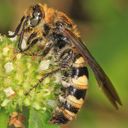
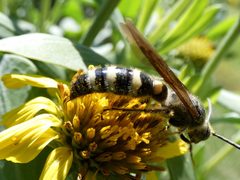
Dielis plumipes fossulana is a of scoliid in the tribe Campsomerini, characterized by females with significantly smaller metasomal tergal yellow bands on T1–T3 compared to the sympatric Dielis tejensis. This wasp occurs in east-central Texas and surrounding Gulf Coastal states, where forage for nectar and larvae develop as of scarab beetle . The exhibits strong typical of the tribe, with males and females differing in body structure and color pattern.
Pronunciation
How to pronounce Dielis plumipes fossulana: /ˈdiː.ɛ.lɪs ˈpluː.mɪ.ˌpiːz ˌfɒs.jʊˈlɑː.nə/
These audio files are automatically generated. While they are not always 100% accurate, they are a good starting point.
Identification
Females distinguished from Dielis tejensis by smaller metasomal tergal yellow bands on abdominal tergites T1–T3 (Mann–Whitney test, p < 0.01 to p < 0.0001). Mitochondrial divergence from D. tejensis approximately 7% in coding regions. Possesses enlarged nad2-trnW and shortened insert dividing cox2 gene into cox2a and cox2b with TAA in middle of insert. Males exhibit typical Campsomerini with differences in antennal structure and coloration from females.
Images
Habitat
East-central Texas savannas and prairies; Gulf Coastal Plains; open woodland, savanna and grassland on sandy and loamy soils with clay-loam bottomlands; humid subtropical climate (Cfa Köppen classification)
Distribution
USA: Texas (Harris County, Houston area; historically more numerous, now reduced), Florida, Louisiana;
Diet
forage for nectar; larvae develop as idiobiont ectoparasitoids of , primarily Scarabaeidae
Life Cycle
Multi-generational with more than one per year; possible female stage inferred from related D. tejensis
Behavior
(burrowing) lifestyle; contribute to plant pollination while foraging for nectar
Ecological Role
agent for scarab beetle ; of flowering plants; potential economic importance for agriculture
Human Relevance
Potential value in for scarab beetle control in agricultural and turf systems; subject of taxonomic research clarifying boundaries in the Dielis
Similar Taxa
- Dielis tejensisFemales closely resemble D. plumipes fossulana and occur in partial sympatry in Harris County, Texas; distinguished by larger metasomal tergal yellow bands and approximately 7% mitochondrial divergence
- Dielis plumipes (nominate subspecies)Parent ; subspecific distinction based on morphological and molecular characteristics requiring further geographic sampling to clarify range boundaries
Sources and further reading
- BugGuide
- NCBI Taxonomy
- Ziad Khouri: Zeroing in on Mammoth Wasps, the Scoliid Wasps | Bug Squad
- Gardening for Solitary Bees - Buglife Blog - Buglife
- How a Colorado Extension Entomologist Wrangles Pests and Protects Biodiversity
- Spring is sprung… - Buglife Blog - Buglife
- Group mimicry in Cerambycidae… and more | Beetles In The Bush
- Bug Eric: Spider Sunday: Dewdrop Spiders
- Alloreferent and Apparent Seasonal Polyphenism of Dielis tejensis with an Updated Key to Nearctic Dielis Species (Hymenoptera: Scoliidae)