
Pelecinus
Wiedemann, 1823
American pelecinid wasps, snake-tailed wasps
Species Guides
1- Pelecinus polyturator(American Pelecinid Wasp)
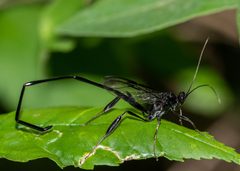
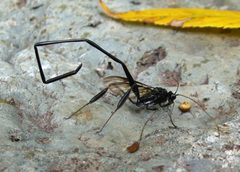
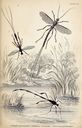
Pelecinus is the sole living of the Pelecinidae, containing three restricted to the New World. Females are immediately recognizable by their extraordinarily elongated, thread-like that can exceed 5 cm in length, used to probe soil and deposit on scarab beetle larvae. The genus represents a relict lineage with extensive fossil diversity dating to the early Cretaceous across multiple continents.
Pronunciation
How to pronounce Pelecinus: //pɛˈlɛsɪnəs//
These audio files are automatically generated. While they are not always 100% accurate, they are a good starting point.
Identification
Females are unmistakable due to the snake-like, extremely elongated —no other North American approaches this . Males are more easily confused with small ichneumon wasps but can be distinguished by the swollen hind tibiae and shorter, widened abdomen tip. The combination of all-black coloration and inflated hind legs separates both sexes from superficially similar .
Images
Habitat
Mesic forests, woodland edges, and riparian corridors. are frequently encountered in hardwood forest understories and shaded areas. The requirements reflect the need for suitable scarab beetle in soil. Specimens have been recorded in both natural forests and landscaped areas adjacent to suitable habitat.
Distribution
New World only. Pelecinus polyturator occurs from southern Canada through the United States, Mexico, and Central America to Argentina. Pelecinus thoracicus is restricted to Mexico. Pelecinus dichrous occurs in South America. The has been recorded in humid mountain ranges of northeastern Brazil (Ceará state) and is present across the eastern United States west to the Rocky Mountains.
Seasonality
activity peaks in July and August in temperate North America, with some individuals persisting into September or rarely October. In tropical regions, activity corresponds with rainy season peaks—March in Ceará, Brazil.
Host Associations
- Phyllophaga larvae (Scarabaeidae) - Larvae of 'May beetles' or 'June beetles' are the only documented . Females use elongated to probe soil and deposit directly on buried scarab .
Life Cycle
Larval development occurs within or on scarab beetle ; specific details of whether is internal or external remain undocumented. and pupae have been found in pasture soils. The complete duration is unknown.
Behavior
Females are active fliers, frequently attracted to lights at night. They engage in extensive , folding the elongated to reach it with hind legs. Males are rarely encountered, particularly in northern where may occur. location involves probing soil with the abdomen to detect buried scarab larvae.
Ecological Role
Specialized of scarab beetle larvae, potentially contributing to regulation of white in pastures and forests. The extreme morphological specialization suggests tight with scarab .
Human Relevance
No economic importance as a pest; non-stinging and harmless to humans. Occasionally encountered in urban parks and gardens adjacent to natural . Potential value as a agent for scarab pests, though not actively utilized.
Similar Taxa
- Megarhyssa spp.Also large, striking with extreme ovipositor length, but proportions differ dramatically
- Gasteruption spp.Have elongated and are sometimes mistaken for pelecinids, but lack the extreme attenuation and swollen hind tibiae
Misconceptions
The elongated is frequently mistaken for a giant stinger, causing unnecessary alarm. The is incapable of stinging humans. The rarity of males in northern has led to speculation about , though this remains incompletely confirmed.
More Details
Evolutionary significance
Pelecinidae represents a relict lineage with fossil diversity extending to the early Cretaceous (121–124 mya). Fossil pelecinids from that era include 43 in 12 across North America, Europe, and Asia, indicating the modern three species are remnants of a once-diverse group.
Reproductive biology
Males constitute only approximately 4% of collection records north of Mexico, suggesting either extreme rarity, shorter lifespan, or geographic in temperate . Thelytoky (production of females from unfertilized ) would be unusual in Hymenoptera given haplodiploid sex determination.
Sources and further reading
- BugGuide
- Wikipedia
- iNaturalist taxon
- NCBI Taxonomy
- Catalogue of Life
- Bug Eric: The American Pelecinid Wasp
- Hymenoptera | Beetles In The Bush | Page 5
- The ants, bees and wasps of Canada, Alaska and Greenland – a checklist of 9250 species | Blog
- Bug Eric: A One Millimeter Mystery
- ECONOMIC IMPORTANCE AND HOST RELATIONSHIP OF PELECINUS POLYTURATOR DRURY
- Biodiversity of Root-Nodule Bacteria Associated With the Leguminous Plant Biserrula pelecinus
- First record of Pelecinus polyturator (Drury, 1773) (Hymenoptera: Pelecinidae) from Ceará state, Brazil
- A NOTE ON PELECINUS POLYTURATOR (HYMENOPTERA: PELECINIDAE), A PARASITE OF PHYLLOPHAGA ANXIA (COLEOPTERA: SCARABAEIDAE)
- Distribution of <i>Pelecinus Polyturator</i> in Wisconsin (Hymenoptera: Pelecinidae), With Speculations Regarding Geographical Parthenogenesis
- In search of photosensitising compounds in the annual forage legume Biserrula pelecinus L.
- Mesorhizobium ciceri biovar biserrulae, a novel biovar nodulating the pasture legume Biserrula pelecinus L.
- Genetic variation in populations of two Mediterranean annual pasture legumes ( Biserrula pelecinus L. and Ornithopus compressus L.) and associated rhizobia