
Allochares azureus
(Cresson, 1867)
Allochares azureus is a spider wasp and the sole in its . It is distinguished by unusual and specialized hunting targeting the southern house spider. The species exhibits blue-green iridescence due to body hairs and has multiple per year.
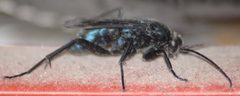
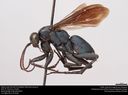
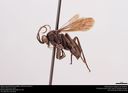
Pronunciation
How to pronounce Allochares azureus: /ˌæloʊˈkɛəriˌzæʒʊˈreɪəs/
These audio files are automatically generated. While they are not always 100% accurate, they are a good starting point.
Identification
Distinguished from other spider wasps by the combination of: convex and concave shape; excavated propodeum with posterior-facing conical teeth; absence of tarsal comb in females; and blue-green iridescent sheen. The lack of spines and modified tarsal claws separates it from web-hunting relatives.
Images
Appearance
Body black with blue or green iridescence caused by short hairs. convex anteriorly and concave posteriorly, particularly pronounced in males. Propodeum excavated with conical teeth directed posteriorly. Females lack a tarsal comb. Females measure 9–13.5 mm, males 7–10 mm.
Habitat
Associated with containing the southern house spider, including human structures and natural settings with suitable web-building substrates. visit flowering plants in open or semi-open areas.
Distribution
Southern : southern United States from Florida to California, south to Mexican states of Jalisco and Veracruz.
Seasonality
active year-round with multiple per year; peak activity likely coincides with availability of spiders and flowering nectar sources.
Diet
feed on nectar from flowers of Baccharis, Solidago, Acacia, Asclepias, Condalia, Hyptis emoryi, and Colubrina texensis. Larvae are obligate , feeding exclusively on paralyzed southern house spiders (Kukulcania hibernalis).
Host Associations
- Kukulcania hibernalis - ; sole known . Female enters spider's tubular retreat in web to attack.
Life Cycle
hatches in 2–3 days. Larva feeds on paralyzed spider for 10–12 days. occurs within a distinct cocoon in the spider's web; cocoon outer surface covered with long silky hairs. Multiple per year.
Behavior
Females hunt on foot with short rapid rushes and wing-flicking, making short of approximately one meter between hunting sites. Upon locating a web, the female enters the spider's tubular retreat. The spider typically retreats and hides motionless in a fissure or adjacent web; the cannot detect stationary spiders. If contact occurs, the spider attempts to flee and the wasp pursues. Attack is from behind, sometimes flipping the spider side up; paralysis is achieved by a sting to the venter. The paralyzed spider is dragged vertically or horizontally back to its web or an unoccupied web, secured using the spider's own silk, and an is deposited. have been observed feeding at flowers.
Ecological Role
regulating of the southern house spider. Contributes to pollination through nectar feeding.
Human Relevance
agent for the southern house spider, a . No documented negative impacts on humans.
Similar Taxa
- Other PompilidaeMost spider wasps possess spines or modified tarsal claws for grappling with spiders; A. azureus lacks these structures as an to hunting in sticky webs without entanglement.
More Details
Morphological adaptations for web hunting
The absence of spines and modified tarsal claws in A. azureus represents a derived condition among spider wasps, interpreted as an to avoid entanglement in the velcro-like threads of the spider's web.