
Dasymutilla waco
(Blake, 1871)
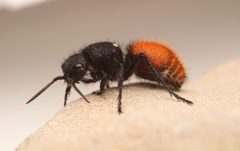
Dasymutilla waco is a of velvet ant ( Mutillidae), a group of solitary in which females are wingless and males are winged. The species was described by Blake in 1871 and belongs to the large Dasymutilla, which contains many brightly colored species known for their powerful sting. Like other velvet ants, females are active ground-dwellers that seek out nests to parasitize. The species epithet "waco" refers to Waco, Texas, suggesting a type locality or association with that region.
Pronunciation
How to pronounce Dasymutilla waco: //ˌdæsɪˈmjʊtɪlə ˈweɪkoʊ//
These audio files are automatically generated. While they are not always 100% accurate, they are a good starting point.
Images
Distribution
The epithet and taxonomic authority suggest an association with Waco, Texas and surrounding regions. As a member of Dasymutilla, it likely occurs in the south-central United States, though specific range boundaries have not been documented in the provided sources. The genus Dasymutilla is broadly distributed across North America from southern Canada to Mexico.
Life Cycle
As a member of Mutillidae, the follows the typical velvet ant pattern: females lay in the nests of ground-nesting bees or , and the larva consumes the pupa or diapausing larva. However, specific host records for D. waco have not been documented.
Ecological Role
As a , likely functions as a regulator of ground-nesting Hymenoptera . The bright aposematic coloration typical of the suggests participation in Müllerian mimicry complexes that warn of defensive capabilities.
More Details
Nomenclature
The specific epithet "waco" is a toponym referring to Waco, Texas, indicating the was described from or named after this location.
Sources and further reading
- BugGuide
- iNaturalist taxon
- NCBI Taxonomy
- 'Carey's Equality' Explained--and Much, Much More | Bug Squad
- A Unique Project: A Video Guidebook to Showcase a Scientific Textbook | Bug Squad
- Big Blue: A Sweet Ride for a Cabbage White Butterfly | Bug Squad
- Bug Eric: Wasp Wednesday: Dasymutilla bioculata
- The gloriously dichromatic Dasymutilla gloriosa | Beetles In The Bush
- A sting to kill a cow? Red velvet ant, a.k.a. cow killer, Dasymutilla occidentalis — Bug of the Week