
Dasymutilla sicheliana
(Saussure, 1868)
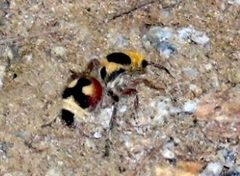
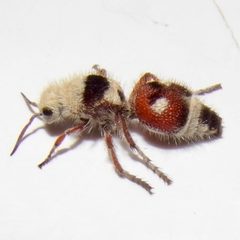
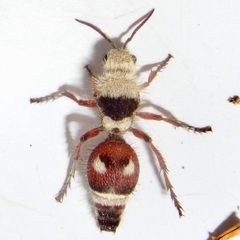
Dasymutilla sicheliana is a of velvet ant ( Mutillidae), a group of solitary in which females are wingless and males are winged. The species occurs in arid regions of the southwestern United States and Mexico. Like other Dasymutilla species, females possess a powerful sting used for defense and subjugation. The species develops as an external parasitoid of ground-nesting bees and wasps.
Pronunciation
How to pronounce Dasymutilla sicheliana: //ˌdeɪ.saɪ.mjuːˈtɪl.lə ˌsɪ.kəˈliː.ə.nə//
These audio files are automatically generated. While they are not always 100% accurate, they are a good starting point.
Identification
Specific diagnostic features for D. sicheliana are not documented in available sources. As a member of Dasymutilla, females are wingless with a velvety ; males possess wings. -level identification within Dasymutilla typically requires examination of color pattern, hair , and microscopic structural features. D. sicheliana has been observed in Arizona and Mexico, which may help distinguish it from similar species with more eastern or northern distributions.
Images
Habitat
Arid and semi-arid environments including desert and dry grassland regions. The has been documented in Arizona and Mexico, suggesting to warm, dry conditions with sandy or well-drained soils suitable for nesting.
Distribution
Mexico and the U.S. state of Arizona.
Host Associations
- Ground-nesting bees and wasps - As with other Dasymutilla , D. sicheliana likely parasitizes nests of solitary bees and , though specific remain undocumented.
Life Cycle
Females are wingless and search for nests on the ground. Upon locating a host nest, the female enters and lays an on or near the host larva or pupa. The developing velvet ant larva consumes the host. Males are winged and fly to seek mates and nectar sources. Specific details of D. sicheliana's developmental stages and timing are not documented.
Behavior
Females run rapidly across the ground in search of nests. Both sexes have been observed feeding on plant exudates including sap flows and possibly floral secretions. When disturbed, females may produce an audible squeak (stridulation) by rubbing abdominal segments together, a defensive common in the .
Ecological Role
Acts as a , regulating of ground-nesting bees and . may contribute to nutrient cycling through feeding on sap flows and other plant exudates.
Human Relevance
Females can deliver a painful sting if handled; caution is advised. The is not considered a pest and has no significant economic impact. Like other velvet ants, it may attract attention due to its striking appearance and rapid movements.
Similar Taxa
- Dasymutilla occidentalisSimilar bright aposematic coloration and wingless female , but D. occidentalis occurs primarily in eastern North America rather than the Southwest/Mexico.
- Dasymutilla gloriosaShares characteristics including and lifestyle, but D. gloriosa females are densely covered in white hairs mimicking creosote bush seeds, a distinctive trait not reported for D. sicheliana.
- Dasymutilla bioculataOccurs in similar arid western and was historically confused with multiple similar ; D. bioculata was taxonomically lumped from 21 former species in 2010, highlighting the difficulty of species-level identification in this group without molecular or detailed morphological analysis.
More Details
Taxonomic history
The was described by Saussure in 1868. Dasymutilla as a has undergone significant taxonomic revision, with molecular studies revealing that morphological variation previously used to define species was often insufficient for species boundaries.
Observation frequency
As of available records, iNaturalist documents 353 observations of this , indicating it is encountered with moderate frequency by naturalists in its range, though specific abundance data are lacking.
Sources and further reading
- BugGuide
- Wikipedia
- iNaturalist taxon
- NCBI Taxonomy
- Insect FAQs | Entomology Research Museum
- Bug Eric: Wasp Wednesday: Dasymutilla bioculata
- The gloriously dichromatic Dasymutilla gloriosa | Beetles In The Bush
- A sting to kill a cow? Red velvet ant, a.k.a. cow killer, Dasymutilla occidentalis — Bug of the Week
- Mutillidae | Beetles In The Bush
- Bees vs wasps: what's the difference? - Buglife Blog - Buglife