
Dasymutilla coccineohirta
(Blake, 1871)
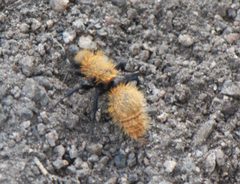
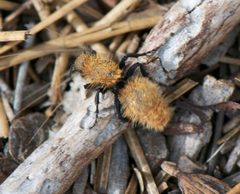
Dasymutilla coccineohirta is a of velvet ant ( Mutillidae) native to western North America. Females are wingless and possess a potent sting, while males are winged. The species exhibits notable variation in female coloration, with setae ranging from red to white. First described by Charles Alfred Blake in 1871 from a California specimen, it was recently synonymized with Dasymutilla clytemnestra. The species can be distinguished from similar by its smaller marginal wing and coarser body pilosity.
Pronunciation
How to pronounce Dasymutilla coccineohirta: //ˌdæ.sɪ.mjuːˈtɪl.ə ˌkɒk.sɪˌniː.oʊˈhɜːr.tə//
These audio files are automatically generated. While they are not always 100% accurate, they are a good starting point.
Identification
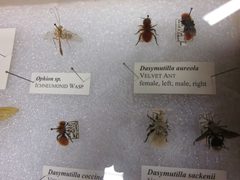
Distinguished from Dasymutilla fulvohirta by the smaller marginal of the wing and much coarser body clothing (pilosity). The variable female setal coloration (red to white) is also a notable feature. Males can be difficult to associate with females due to pronounced sexual dichromatism.
Images
Appearance
Females are wingless with dense, velvety setae covering the body. The coloration of this setae is highly variable, ranging from red to white. Males possess wings and differ in appearance from females, a common trait in the . The body pilosity is notably coarse compared to related .
Distribution
Pacific coastal region of western North America, from Washington and Idaho south to Baja California state.
Similar Taxa
- Dasymutilla fulvohirtaSimilar in general appearance but distinguished by larger marginal wing and finer body pilosity
- Dasymutilla gloriosaAnother Dasymutilla with highly variable female appearance, though D. gloriosa females are specifically adapted to mimic creosote bush seeds with white setae
More Details
Taxonomic History
Dasymutilla clytemnestra was recently synonymized with D. coccineohirta. The was first described by Charles Alfred Blake in 1871 from a specimen collected in California.
Sources and further reading
- BugGuide
- Wikipedia
- iNaturalist taxon
- NCBI Taxonomy
- Insect FAQs | Entomology Research Museum
- Bug Eric: Wasp Wednesday: Dasymutilla bioculata
- The gloriously dichromatic Dasymutilla gloriosa | Beetles In The Bush
- A sting to kill a cow? Red velvet ant, a.k.a. cow killer, Dasymutilla occidentalis — Bug of the Week
- Mutillidae | Beetles In The Bush
- Bees vs wasps: what's the difference? - Buglife Blog - Buglife