
Dasymutilla californica
(Radoszkowski, 1861)
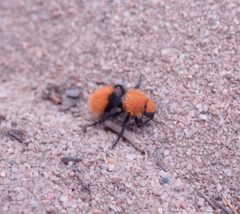
Dasymutilla californica is a of velvet ant ( Mutillidae) native to California and adjacent regions. Like all mutillids, females are wingless and possess a potent sting, while males are winged and do not sting. This species is part of a large of solitary that target ground-nesting bees and wasps. The species name reflects its primary geographic association with California.
Pronunciation
How to pronounce Dasymutilla californica: /ˌdeɪsɪˈmjʊtɪlə ˌkælɪˈfɔrnɪkə/
These audio files are automatically generated. While they are not always 100% accurate, they are a good starting point.
Identification
Dasymutilla californica can be distinguished from other western North American mutillids by its geographic restriction to California and adjacent areas, combined with specific morphological characters used in -level of the . Males may be distinguished from females by the presence of wings. Differentiation from other Dasymutilla species requires examination of microscopic features such as antennal structure, setal patterns, and genitalia. The species name 'californica' indicates primary occurrence in California, distinguishing it from eastern species such as D. occidentalis.
Images
Appearance
Females are wingless with a robust, -like body form covered in dense setae. Males possess two pairs of wings and are typically more slender. Specific coloration patterns for D. californica are not well documented in available sources, though Dasymutilla generally exhibit aposematic coloration in red, black, orange, or white combinations. Both sexes have a thick, durable .
Habitat
Arid and semi-arid including deserts, prairies, and open sandy areas. Associated with regions supporting of ground-nesting bees and . In California, occurs in habitats where suitable host nesting substrates—typically sandy or friable soils—are present.
Distribution
California and adjacent regions of western North America. The specific epithet and authority (Radoszkowski, 1861) indicate this is one of the earlier-described in the , with type locality presumably in California.
Seasonality
active during warmer months when are nesting. Specific not documented in available sources.
Life Cycle
Presumed of ground-nesting bees or based on -level . Female invades nest, lays on or near host larva or pupa. Larva consumes host, pupates, and emerges as . Specific host records for D. californica not found in available sources.
Behavior
Females run rapidly across open ground searching for nests. Both sexes produce audible stridulation by rubbing abdominal segments together, a defensive warning signal. Females are solitary and non-social. Males fly in search of mates and nectar sources.
Ecological Role
of ground-nesting Hymenoptera, contributing to of . Aposematic coloration participates in Müllerian mimicry complexes with other stinging insects.
Human Relevance
Females can deliver a painful sting if handled; avoidance recommended. Not aggressive but will defend if restrained. No significant economic impact; occasionally encountered by entomologists and naturalists in California.
Similar Taxa
- Dasymutilla occidentalisEastern North American 'cow killer' with similar but different geographic range; distinguished by distribution and subtle morphological differences
- Dasymutilla bioculataWidespread across North America; D. californica distinguished by California-centered distribution and lack of the specific markings implied by 'bioculata' (two-eyed)
- Dasymutilla gloriosaSouthwestern with highly distinctive sexually dichromatic coloration—females densely white-haired, mimicking creosote bush seeds; D. californica lacks this extreme mimicry
More Details
Taxonomic note
Dasymutilla californica was described by Radoszkowski in 1861, making it one of the earlier described in this large New World . The genus Dasymutilla has undergone significant taxonomic revision, with many species synonymized based on molecular data (e.g., 21 former species/ lumped under D. bioculata in 2010). The status of D. californica as a distinct species has not been explicitly challenged in recent literature.
Conservation
No specific conservation status documented. Like many solitary , vulnerable to loss through development and soil disturbance affecting nesting sites.
Sources and further reading
- BugGuide
- iNaturalist taxon
- NCBI Taxonomy
- Insect FAQs | Entomology Research Museum
- The Big 43: The California Native Plants, Plus One, Studied in UC Davis Research | Bug Squad
- Bohart Museum: Learn about California's State Insect on UC Davis Picnic Day | Bug Squad
- Bug Eric: Wasp Wednesday: Dasymutilla bioculata
- The gloriously dichromatic Dasymutilla gloriosa | Beetles In The Bush
- A sting to kill a cow? Red velvet ant, a.k.a. cow killer, Dasymutilla occidentalis — Bug of the Week