
Dasymutilla arenivaga
Mickel, 1928
Desert Velvet Ant
Dasymutilla arenivaga is a of velvet ant in the Mutillidae, first described by Mickel in 1928. Like all mutillids, it is a solitary with wingless females and winged males, exhibiting the pronounced characteristic of this group. The species inhabits arid and semi-arid regions of the southwestern United States and northwestern Mexico.
Pronunciation
How to pronounce Dasymutilla arenivaga: //ˌdæsɪˈmjʊtɪlə ˌærɪˈnaɪvɑːɡə//
These audio files are automatically generated. While they are not always 100% accurate, they are a good starting point.
Identification
Dasymutilla arenivaga can be distinguished from other Dasymutilla by male genitalia characters, as species in this are primarily separated based on complex genitalic . The species name 'arenivaga' (wandering in sand) suggests association with sandy desert , which may aid in field identification. Association of females with males remains challenging due to pronounced .
Images
Appearance
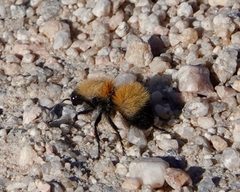
Females are wingless, -like in appearance, and covered in dense, velvety setae. Males possess two pairs of wings and are typically more -like in form. Specific coloration patterns for D. arenivaga are not well documented in available sources, though the generally exhibits aposematic coloration of red, orange, or yellow combined with black.
Habitat
Arid and semi-arid desert environments, including sandy areas. The specific epithet 'arenivaga' indicates a wandering habit in sandy substrates. Found in desert scrub and dryland of the southwestern United States and adjacent Mexico.
Distribution
United States: Arizona, California, and Nevada. Mexico: Baja California, Hidalgo, and Sonora.
Seasonality
Males active from late June through early September. Females collected from late July through October, with peak activity in August through October.
Life Cycle
As with other mutillids, females are ectoparasitoids of ground-nesting Hymenoptera. The larval stage develops as a on the pupae or larvae of or bees. Specific host records for D. arenivaga are not documented.
Behavior
Females run rapidly across the ground in search of nests, using their powerful and venomous sting to overcome host defenses. Both sexes produce audible stridulation by rubbing abdominal segments together, likely serving as a defensive warning. Males fly in search of nectar, pollen, and mates.
Ecological Role
of ground-nesting bees and , contributing to regulation of . Part of Müllerian mimicry complexes involving other aposematically colored Hymenoptera and mimetic insects.
Human Relevance
Females can deliver a painful sting if handled, though they are not aggressive and sting only in defense. The 'cow killer' applied to related reflects exaggerated folklore about sting potency. Of interest to entomologists and collectors due to taxonomic complexity and striking appearance.
Similar Taxa
- Dasymutilla gloriosaAlso inhabits southwestern deserts, but females are densely covered in long white hairs resembling thistledown, unlike D. arenivaga
- Dasymutilla occidentalisEastern North American with bright red and black aposematic coloration; with D. arenivaga
- Dasymutilla bioculataWidespread recently expanded through taxonomic lumping; distinguished by genitalia and molecular markers
Misconceptions
Velvet ants are frequently mistaken for true ants (Formicidae) due to wingless females and , but they are solitary . The 'cow killer' name applied to relatives reflects folklore exaggeration of sting potency—no documented cases of livestock mortality exist.
More Details
Taxonomic History
The was described by Clarence Mickel in 1928. Species-level in Dasymutilla remains challenging due to extreme and historical reliance on male genitalia characters. Recent molecular work has led to significant revisions, including lumping of multiple former species into broadly defined species such as D. bioculata.
Collection Challenges
The rapid, erratic running of females makes them difficult to collect or photograph. Specimens are often obtained as bycatch by collectors or through targeted searching in appropriate .
Sources and further reading
- BugGuide
- GBIF taxonomy match
- iNaturalist taxon
- NCBI Taxonomy
- Bug Eric: Wasp Wednesday: Dasymutilla bioculata
- The gloriously dichromatic Dasymutilla gloriosa | Beetles In The Bush
- A sting to kill a cow? Red velvet ant, a.k.a. cow killer, Dasymutilla occidentalis — Bug of the Week
- Mutillidae | Beetles In The Bush
- Uncategorized | Blog - Part 26
- Pensoft Editorial Team | Blog - Part 130