
Orussus
Latreille, 1797
Species Guides
4- Orussus minutus
- Orussus occidentalis(Western Orussid Wasp)
- Orussus terminalis
- Orussus thoracicus
Orussus is a of parasitic wood wasps in the Orussidae, comprising approximately 11 described . These are unique among woodwasps for their lifestyle, attacking the stages of wood-boring beetles and other wasps. are rarely encountered and have historically been poorly collected, though citizen science platforms have recently helped expand knowledge of their distribution. The genus has undergone significant taxonomic revision, now placed in its own superfamily within the suborder .

Pronunciation
How to pronounce Orussus: /ɔˈrʊs.sʊs/
These audio files are automatically generated. While they are not always 100% accurate, they are a good starting point.
Identification
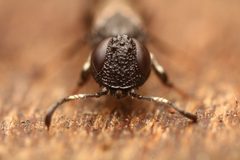
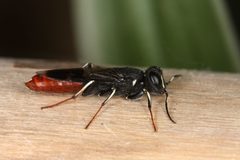
Orussus are frequently mistaken for carpenter ants due to their dark coloration and wing folding pattern; dark bands on otherwise clear wings create this illusion when wings are folded over the back. Diagnostic features include a very globular with inserted just above the mouth, and teeth or on the top of the head. The antennae have thickened, club-like tips. The front tibiae have thin at the tips concealing vibrational receptors used for detection. The ovipositor, when coiled within the thoracic and abdominal cavities, can exceed twice the body length.
Images
Habitat
are found in both coniferous and deciduous forests, particularly along meadow edges and other sunny openings. They are most often observed on logs and dead standing trees where bark has been stripped, showing preference for solid but sun-bleached wood. Specific collection records document occurrence in 80-100 year old mature second-growth Eastern mixed deciduous forest dominated by oak (Quercus) and hickory (Carya).
Distribution
within Orussus occur in North America north of Mexico, with four species documented in this region. Historical records were concentrated in the northeastern United States, but recent discoveries through citizen science have documented significant western range extensions to Arkansas, Iowa, Minnesota, Manitoba, West Virginia, Michigan, and Connecticut. The also occurs in Europe, with Orussus abietinus historically rare in Poland but becoming more numerous in recent decades.
Host Associations
- Buprestidae - jewel beetles; most confirmed North American records
- Cerambycidae - longhorned beetles
- Siricidae - horntails
- Xiphydriidae - woodwasps
Life Cycle
Females deposit into -filled galleries of wood-boring insects, either directly onto larvae or into tunnels. The larva hatches from an extremely long, slender egg and is equipped with backward-curving spines on thoracic and abdominal segments that likely aid movement through tunnels. Upon reaching a host , the orussid larva attaches as an external and feeds on the host.
Behavior
females employ vibrational sounding to locate : they tap their on wood surfaces and detect reverberating echoes through a subgenual organ in each front tibia. Adults pace rapidly back and forth over logs, changing direction abruptly, and are capable of jumping. They are uncommonly collected even with extensive trapping efforts including .
Ecological Role
Orussus function as of wood-boring insects, including beetles and that bore into wood. As natural enemies of technical wood pests (cambio- and xylobionts), they may serve as limiting factors in damage caused by these organisms. They represent the only parasitic among the otherwise herbivorous group.
Human Relevance
Citizen science platforms including Flickr and BugGuide have proven valuable for expanding knowledge of Orussus distribution, with photo records contributing to significant western range extensions for O. minutus. These are not harmful to humans and have minimal economic impact, though their makes them potentially relevant for of wood-boring pest .
Similar Taxa
- Carpenter ants (Camponotus) Orussus are frequently mistaken for carpenter ants due to dark coloration, wing folding pattern, and overall body form; examination of shape, insertion point, and wing venation distinguishes them
- Braconidae and IchneumonidaeOther parasitic wasp ; Orussus was historically misclassified with these groups but differs in anatomical features and is now placed in separate superfamily
- Horntails (Siricidae)Anatomically similar features led to historical classification with this group; Orussus differs in larval versus herbivory in horntails
More Details
Taxonomic history
Orussus has defied proper classification within Hymenoptera. Evidence of parasitic larval lifestyle initially suggested relationship to Braconidae and Ichneumonidae, but anatomical features resemble horntails and . The was at one point placed in its own suborder Idiogastra, then lumped as an aberrant family within , and is now placed in superfamily within suborder .
Collection rarity
Orussus are among the most rarely collected Hymenoptera. Orussus minutus was known from only approximately 50 specimens prior to recent discoveries, and extensive Malaise trapping efforts frequently fail to capture these despite their presence in the .
Sources and further reading
- BugGuide
- Wikipedia
- GBIF taxonomy match
- iNaturalist taxon
- NCBI Taxonomy
- Bug Eric: Wasp Wednesday: Orussid Wasps
- sawfly | Blog
- distribution | Blog
- citizen science | Blog - Part 4
- BugGuide | Blog
- expansion | Blog
- Wnik świerkowiec [Orussus abietinus (Scopoli, 1793)] w Drawieńskim Parku Narodowym, parazytoid o rosnącym znaczeniu?
- New records of Orussus minutus Middlekauff, 1983 (Hymenoptera: Orussidae) represent a significant western range expansion