
Osmia chalybea
Smith, 1853
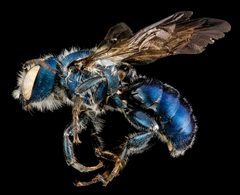
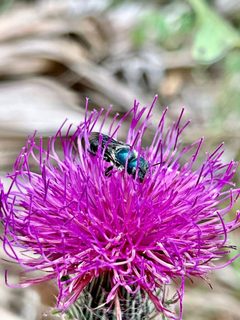
Osmia chalybea is a solitary (Megachilidae) native to North America. It nests in pre-existing cavities and has been studied as a potential for orchard crops, particularly blueberries. The serves as a for the cleptoparasitic Stelis ater. It is one of several Osmia species evaluated for commercial management in agricultural pollination systems.

Pronunciation
How to pronounce Osmia chalybea: //ˈɒs.mi.ə kəˈlɪb.iə//
These audio files are automatically generated. While they are not always 100% accurate, they are a good starting point.
Images
Habitat
Uses pre-existing tubular cavities for nesting, including hollow plant stems and holes in wood. Has been evaluated for managed pollination in orchard and berry crop systems.
Distribution
North America. GBIF records confirm presence in North America; specific state/provincial distributions not detailed in available sources.
Diet
Collects pollen and nectar from flowering plants. Specific floral associations not documented in available sources.
Host Associations
Life Cycle
Solitary with cavity-nesting . Females construct chambers in pre-existing tubular spaces, provision each chamber with a pollen-nectar mass, and deposit a single before sealing the chamber with a mud partition. Larvae develop on the pollen provision, overwinter as in cocoons, and emerge the following spring. Males typically emerge before females (protandry).
Behavior
Females collect pollen and nectar to fashion pollen cakes for larval provisions. After entering a nest cavity -first, females reverse direction to deposit abdominal pollen onto the provision. are non-aggressive toward humans and rarely sting; defensive biting has been observed during handling.
Ecological Role
of native and agricultural flowering plants. Serves as for cleptoparasitic bees, contributing to local structure. Evaluated for commercial pollination services in blueberry and orchard crop systems.
Human Relevance
Studied as a candidate for managed pollination in agricultural systems, particularly for blueberries and orchard fruits. Included in comparative studies with O. lignaria and O. ribifloris for commercial management potential. Subject of research on cavity-nesting bee and dynamics.
Similar Taxa
- Osmia lignariaBoth are North American cavity-nesting mason bees used in orchard pollination studies; O. lignaria is more extensively managed commercially and has been better characterized biologically.
- Osmia ribiflorisBoth evaluated as blueberry in the same comparative study; O. ribifloris received greater research emphasis and has more documented management protocols.
More Details
Research Context
O. chalybea has been primarily studied in the context of comparative management research rather than as a standalone focal . Most detailed biological information comes from studies where it was included as one of multiple Osmia species rather than as the primary subject.
Nesting Biology Documentation
Detailed nesting and developmental has been documented through studies of its Stelis ater, which has provided indirect information about O. chalybea nesting and larval development.
Sources and further reading
- BugGuide
- Wikipedia
- GBIF taxonomy match
- iNaturalist taxon
- NCBI Taxonomy
- Catalogue of Life
- Sharing Research About BOB | Bug Squad
- Welcome mason bees, Osmia spp. — Bug of the Week
- Mason bees make their belated debut, Osmia spp. — Bug of the Week
- Is This Non-Native Mason Bee an Invasive Species?
- European Mason Bee Lands in North America's Pacific Northwest, Likely to Spread
- Honey Bee Heat Warms Up Fellow Pollinators for Early-Season Blooms
- Nesting and Developmental Biology of the Cleptoparasitic BeeStelis ater(Anthidiini) and Its Host,Osmia chalybea(Osmiini) (Hymenoptera: Megachilidae)
- BIOLOGY AND MANAGEMENT POTENTIAL FOR THREE ORCHARD BEE SPECIES (HYMENOPTERA: MEGACHILIDAE): OSMIA RIBIFLORIS COCKERELL, O. LIGNARIA (SAY) AND O. CHALYBEA SMITH WITH EMPHASIS ON THE FORMER