
Osmia caerulescens
(Linnaeus, 1758)
Blue Mason Bee
Osmia caerulescens is a solitary in the Megachilidae. Females construct nests in pre-existing cavities using chewed leaf material and mud partitions. The is polylectic but shows strong preference for Fabaceae pollen. It has a Holarctic distribution with possible human-assisted introduction to North America. In Great Britain and France, the exhibits with two periods per year.

Pronunciation
How to pronounce Osmia caerulescens: /ˈɔs.mi.a sɛrˌuː.leˈsʲɛns/
These audio files are automatically generated. While they are not always 100% accurate, they are a good starting point.
Identification
Distinguished from similar Osmia by the combination of dark blue-black metallic coloration in females (green in males), jet black scopae, and the narrow dense flattened bands of brown hairs on abdominal segment margins. The small size (under 12 mm) and specific metallic hues help separate it from larger or differently colored such as O. lignaria or O. cornuta.
Images
Appearance
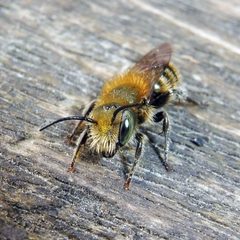
Females are 10–11 mm in length, dark blue-black with metallic sheen, sparsely covered with brown hairs that form narrow dense flattened bands on the hind margin of abdominal segments. The scopae (pollen-collecting hairs) are jet black. Males are smaller (9 mm), more slender, distinctly metallic green, and clothed with pale hairs.
Habitat
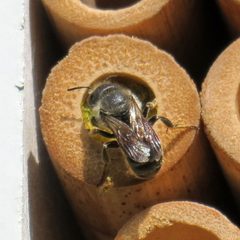
Occurs in diverse including woodland, private gardens, and anthropogenic environments. Nests in pre-existing cavities: insect burrows in dead wood, drilled borings in wooden blocks, hollow stems, pithy stems, ground burrows created by other insects, abandoned of other , cavities in banks, holes and crevices in walls, and artificial substrates such as glass tubes. Reproductive success is higher on sunny hillside aspects compared to shady aspects.
Distribution
Holarctic distribution extending into the Indomalayan region. Palearctic range covers most of Europe and Asia, the Middle East, and North Africa. In Great Britain, mainly found in England and Wales, becoming more localized northward to central Scotland. Also recorded in India. Nearctic occurrence from Minnesota to Nova Scotia, south to Illinois and North Carolina, possibly resulting from human-assisted introduction. Two recognized : O. c. caerulescens (Europe) and O. c. cyanea (North Africa).
Seasonality
in Great Britain and France, partially so in the Netherlands. Two periods in Great Britain: mid-April or May to late July, and again in August. Males emerge first and are active for approximately three weeks. overwinter as diapausing individuals within intact cocoons.
Diet
Polylectic but collects pollen nearly exclusively from Fabaceae. Documented pollen sources include Coronilla, Hippocrepis, Lotus, Medicago, Melilotus, Onobrychis, Trifolium, and Vicia. Has been observed collecting pollen from limited members of Lamiaceae, Asteraceae, Brassicaceae, Hypericaceae, and Ranunculaceae. Females use scopae to comb pollen from nototribic anthers of Lamiaceae and Antirrhineae.
Life Cycle
Solitary with no colonial structure. Females construct individual within cavities, provisioning each with a pollen cake before depositing a single . Cell partitions and nest plugs constructed from masticated leaf material, sometimes with chewed petals; irregularities in burrows lined with leaf pulp. In larger cavities, cells are irregularly arranged with walls partially or wholly built of chewed leaves. Larvae develop through spring, summer, and autumn, completing development by autumn. overwinter in cocoons and emerge the following spring. Protandry observed: males complete development and emerge several days before females.
Behavior
Nests in pre-existing cavities rather than excavating its own. Males emerge before females and wait near nests to mate with emerging females, then guard mates post-copulation to prevent rival matings. Females enter galleries -first, reverse orientation to deposit abdominal pollen onto provision masses. construction involves manipulation of leaf pulp with mouthparts to create partitions and plugs.
Ecological Role
, particularly of Fabaceae . Serves as for kleptoparasitic Sapyga quinquepunctata, which has been reared from O. caerulescens nests. Reproductive success studies indicate to pressure despite higher parasitism rates in favorable areas.
Human Relevance
Utilizes artificial nesting substrates including drilled wooden blocks and glass tubes, making it amenable to study and potential management. No documented agricultural use comparable to managed such as O. lignaria or O. cornifrons. Possible inadvertent transport via human activity implicated in Nearctic distribution.
Similar Taxa
- Osmia lignariaLarger size, different , and distinct coloration; O. caerulescens is smaller (9–11 mm vs. 12–15 mm) and has different metallic coloration
- Osmia cornutaBright red coloration in O. cornuta versus blue-black or green metallic in O. caerulescens; O. cornuta also larger and more robust
- Osmia cornifronsDifferent facial markings and body proportions; O. cornifrons has horns on in males and different
More Details
Nesting Material Specificity
partitions and nest plugs are made of masticated leaf material, sometimes incorporating chewed petals. Any irregularities in nest burrows are lined with leaf pulp. In larger cavities, cells are irregularly arranged and cell walls are partially or wholly built of chewed leaves rather than relying solely on cavity walls.
Kleptoparasitism
The sapygid Sapyga quinquepunctata is a documented kleptoparasite of O. caerulescens. Occupied cocoons of this wasp have been recovered from O. caerulescens nests, and specimens have been reared from nests. rates are higher in areas with favorable characteristics for both , but reproductive success does not appear to decline as a result.
Subspecies Differentiation
Two recognized : O. c. caerulescens (Linnaeus, 1758) occurs in Europe; O. c. cyanea (Fabricius, 1793) occurs in North Africa.
Sources and further reading
- BugGuide
- Wikipedia
- GBIF taxonomy match
- iNaturalist taxon
- NCBI Taxonomy
- Catalogue of Life
- Sharing Research About BOB | Bug Squad
- Bug Eric: Masters of Mud: Auplopus Spider Wasps
- Welcome mason bees, Osmia spp. — Bug of the Week
- Mason bees make their belated debut, Osmia spp. — Bug of the Week
- Is This Non-Native Mason Bee an Invasive Species?
- European Mason Bee Lands in North America's Pacific Northwest, Likely to Spread
- Effects of hillside aspect, landscape features, and kleptoparasitism on the reproductive success of the solitary bee Osmia caerulescens