
Hoplitis producta
(Cresson, 1864)
Produced Small-Mason
Hoplitis producta is a solitary in the Megachilidae, commonly known as the Produced Small-Mason. It is native to North America east of the Rocky Mountains and is considered common and widely distributed in this range. The species is notable for its nesting , having been documented using pith-filled plant stems for nest construction.
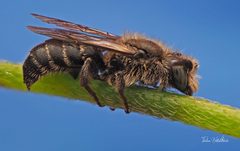
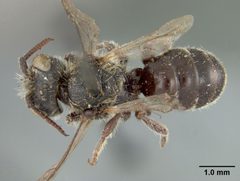
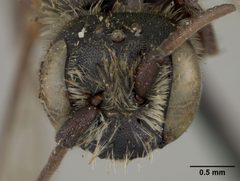
Pronunciation
How to pronounce Hoplitis producta: /hɒˈplaɪtɪs prəˈdʌktə/
These audio files are automatically generated. While they are not always 100% accurate, they are a good starting point.
Images
Habitat
In Wisconsin, nests have been found in the pith at the butt ends of sumac sticks. The uses pith-filled stems of sumac, elder, and rose as nesting substrates. Nests are recognizable by a 3 mm plug that closes the burrow, which has a more solid texture and darker color than the surrounding pith.
Distribution
North America east of the Rocky Mountains; recorded in Wisconsin and widely distributed across eastern North America. GBIF records indicate presence in North America and Middle America.
Behavior
Females excavate their own burrows in pithy stems rather than utilizing pre-existing tunnels left by other twig-dwelling insects. In trap-nest studies using freshly cut sumac sticks placed in spring, each recorded nest represents a burrow excavated by the foundress .
Human Relevance
The has been studied in trap-nest research programs focused on bees and , contributing to understanding of solitary nesting .
More Details
Nesting Biology
Multiple authors have reported on the nesting of Hoplitis producta due to its common occurrence. Rau (1928) found nests in tunnels of elder, sumac, or rose stems but could not determine whether the excavated its own burrows or used those left by other twig-dwellers. Fischer (1955) concluded that the female almost invariably excavates her own burrow. Wisconsin trap-nest studies with freshly cut sumac sticks confirmed this , as all records represented nests in burrows excavated by foundress bees.