
Hoplitis anthocopoides
(Schenck, 1853)
Viper's Bugloss Small-Mason
Hoplitis anthocopoides is a solitary in the Megachilidae. It is a of Echium vulgare (viper's bugloss), using this plant for both pollen/nectar collection and leaf material for nest construction. Females construct nests in pre-existing cavities using cut leaf pieces, creating linear series of 6-10 . Males exhibit territorial , defending flower patches to gain access to females. The has a broad distribution across Africa, Europe, Northern Asia (excluding China), and North America.
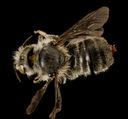
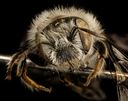
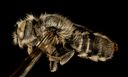
Pronunciation
How to pronounce Hoplitis anthocopoides: //ˈhɒplɪtɪs ˌænθəˌkɒpɔɪˈdiːz//
These audio files are automatically generated. While they are not always 100% accurate, they are a good starting point.
Identification
Can be distinguished from other Hoplitis by its specialized association with Echium vulgare. Females cut distinctive circular or oval leaf pieces from this plant for nest construction, leaving characteristic excisions on leaves. Males may be observed perching on or near Echium flowers and engaging in territorial chases of males.
Images
Habitat
Areas where Echium vulgare (viper's bugloss) grows, including open, disturbed and grasslands. Nests in pre-existing cavities such as borings in dead wood, hollow stems, or crevices in walls and rocks.
Distribution
Africa, Europe, Northern Asia (excluding China), and North America.
Diet
feed on nectar from Echium vulgare. Females provision nest with a mixture of pollen and nectar from Echium vulgare for larval consumption.
Host Associations
- Echium vulgare - pollen and nectar source; leaf material for nest constructionObligate relationship; has been observed to use this plant exclusively for both nutrition and nesting materials
Life Cycle
Females construct linear series of 6-10 in pre-existing cavities. Each cell is provisioned with a pollen-nectar mixture and sealed with cut leaf pieces. Offspring sex is determined by cell size and provision quantity: larger cells with more provisions produce females, smaller cells produce males. Males typically emerge before females.
Behavior
Females exhibit highly stereotyped nest-building : inspecting cavities, constructing basal leaf plugs, provisioning , depositing , and sealing cells with leaf pieces. They use and legs to precisely cut circular/oval leaf pieces and can repair damaged nests. Males establish and defend territories on flower patches where females forage, perching on or near flowers and chasing intruding males; larger males are more successful at holding territories.
Ecological Role
of Echium vulgare. As a cavity-nesting , it contributes to pollination services in where its plant occurs.
Similar Taxa
- Other Hoplitis speciesMay share general and cavity-nesting , but differ in plant associations and geographic distribution
- Other Megachilidae (leafcutter and mason bees)Similar nest construction using leaf or resin materials, but H. anthocopoides is distinguished by its specific use of Echium vulgare leaf pieces and its specialized relationship
More Details
Nesting Materials
Unlike some mason bees that use mud or resin, H. anthocopoides exclusively uses cut leaf pieces from its plant Echium vulgare for nest construction, making it a 'leaf-mason' rather than a typical mud-.
Sex Determination
Females control offspring sex through manipulation of size and provision quantity, a form of common in bees but specifically documented in this .
Sources and further reading
- BugGuide
- Wikipedia
- GBIF taxonomy match
- iNaturalist taxon
- NCBI Taxonomy
- Catalogue of Life
- | Top 10 new species of 2024
- biodiversity | Blog - Part 11
- Bug Eric: A Beautiful Place to "Bee"
- Nest-building Behavior of the Mason Bee Hoplitis anthocopoides (Hymenoptera: Megachilidae)
- Male territorial behaviour in the mason bee Hoplitis anthocopoides (Hymenoptera: Megachilidae)