
Megachile fidelis
Cresson, 1878
Faithful Leafcutting Bee, Horn-faced Leafcutter Bee
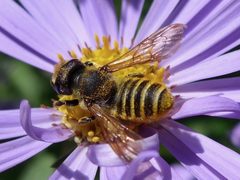
Megachile fidelis is a solitary leafcutting native to western North America. Females construct nests using circular pieces cut from leaves or petals, which they carry back to pre-existing cavities. The is an important native frequently observed in gardens and meadows, where it forages on composite flowers. emerge in spring and exhibit a distinctive nesting where offspring remain in until all intervening cells have been vacated.
Pronunciation
How to pronounce Megachile fidelis: //ˌmɛɡəˈkaɪliː fɪˈdɛlɪs//
These audio files are automatically generated. While they are not always 100% accurate, they are a good starting point.
Identification
Distinguished from other western Megachile by the combination of black body with extensive golden-yellow hair covering, particularly on the and . The abdominal scopa separates it from bees in other . Similar to M. perihirta (Western Leafcutting ) in general appearance and nesting , but specific distinguishing features require close examination. The "horn-faced" refers to facial characteristics that may aid identification.
Images
Habitat
Occupies meadows, gardens, and urban green spaces with available flowering plants and suitable nesting substrates. Requires access to soft, pithy stems or pre-existing cavities for nesting, plus nearby sources of leaves or petals for nest construction.
Distribution
Western United States and adjacent regions of Middle America. Ranges from Montana and South Dakota south to New Mexico, westward through California, and north to Oregon.
Seasonality
active in spring. from nests occurs around spring, with precise timing varying by locality and conditions.
Diet
Feeds on nectar of flowers, particularly composite flowers (Asteraceae). Has been observed foraging on Mexican sunflower (Tithonia rotundifolia), sneezeweed (Helenium autumnale), and other garden plants.
Life Cycle
Solitary with nest construction in pre-existing cavities. Females cut circular pieces from leaves or petals to line . Larvae develop rapidly within brood cells. do not emerge until all cells between their cell and the tunnel exit have been vacated, a distinctive sequential pattern.
Behavior
Females cut leaf or petal fragments with their and transport these pieces to nest sites, flying with the material held beneath the body. Exhibits sequential from nests, where individuals wait for preceding to empty before exiting. Territorial not reported; males do not patrol or defend resources aggressively.
Ecological Role
Native of wild and cultivated plants. Contributes to pollination of composite flowers and other forage plants. Provides services in urban and agricultural landscapes through pollination activity.
Human Relevance
Valued as a native in gardens and agricultural settings. Frequently photographed and studied in pollinator gardens such as the UC Davis Häagen-Dazs Haven. Nesting habits can be supported by providing hotels with drilled holes or hollow stems.
Similar Taxa
- Megachile perihirtaWestern Leafcutting shares nearly identical nest construction methods and general appearance. Distinguishing features require detailed morphological examination.
- Other Megachile speciesMany western Megachile share leafcutting and similar body plans. M. fidelis distinguished by golden hair coloration and specific facial characteristics.
More Details
Nesting Material Transport
Photographic documentation shows females carrying Clarkia petals and other plant fragments, demonstrating flexibility in material selection beyond true leaves.
Research Significance
Among more than 80 documented in the Häagen-Dazs Haven monitoring study, representing the diversity of native bees in California urban gardens.
Sources and further reading
- BugGuide
- Wikipedia
- GBIF taxonomy match
- iNaturalist taxon
- NCBI Taxonomy
- Catalogue of Life
- Photographer Allan Jones Exudes Patience, Skill and Talent | Bug Squad
- International Exposure for Three UC Davis-Affiliated Photographers | Bug Squad
- A Big Bee Bash Is Beckoning: Learn About California's Native Bees | Bug Squad
- Learn About the Diversity of Bees in This UC Davis Biodiversity Museum Month Program | Bug Squad
- Going Native: Do You Know the Native Bees of California? | Bug Squad
- Pollination Ecologist Neal Williams: The Importance of Native Bees | Bug Squad