
Megachile angelarum
Cockerell, 1902
angel of death bee
Megachile angelarum is a solitary cavity-nesting in the Megachilidae, first described by Cockerell in 1902. Unlike typical leafcutter bees in its , it does not cut leaves or petals for nest construction, instead using resin and gum. The is native to western North America, ranging from southern British Columbia to Baja California, with most records from California. Females construct individual nests in pre-existing cavities and are important native .
Pronunciation
How to pronounce Megachile angelarum: /ˌmeɡəˈkaɪli ænˈdʒɛlərʊm/
These audio files are automatically generated. While they are not always 100% accurate, they are a good starting point.
Identification
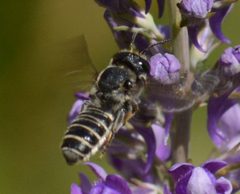
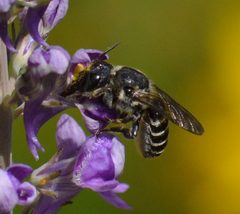
Females distinguished from the similar Megachile campanulae by the presence of complete white fascia on T5 (absent in M. campanulae). Parallel-sided and lack of cutting edges on separate it from typical leafcutter bees. Abdominal scopa and deep grooves on T2-T4 provide additional diagnostic characters. Most reliably identified by the combination of white-banded abdomen and resin-collecting rather than leaf-cutting .
Images
Appearance
Medium-sized solitary with a parallel-sided metasoma (). Females possess complete white fasciae (bands) on tergites T1 through T5. The abdominal scopa—a dense brush of pollen-collecting hairs—is located on the underside of the abdomen. lack cutting edges, distinguishing it from leaf-cutting relatives. Deep grooves present on tergites T2 to T4. Female T6 has a distinct turned-up lip at the terminal end.
Habitat
Occupies diverse natural and anthropogenic landscapes including forests, grasslands, and urban areas. Nesting occurs in pre-existing cavities in wood, plant stems, and other sheltered locations. Has been observed in residential gardens and parks within its range.
Distribution
Western North America: southern British Columbia, Canada; California, Arizona, and New Mexico, United States; Baja California, Mexico. Most records concentrated in California. Range extends from southern British Columbia south to Tijuana.
Diet
feed on nectar; larvae provisioned with pollen collected on abdominal scopa. Specific plant associations not documented.
Life Cycle
Solitary development with no colony structure. Females independently construct nests in cavities, provision with pollen, and lay individual on pollen balls. Developmental stages include egg, larva, pupa, and ; specific timing undocumented.
Behavior
Cavity-nesting that collects resin and gum for nest construction rather than cutting leaves. Solitary foraging and nesting; females perform all -rearing tasks independently. No territorial or social documented.
Ecological Role
Native contributing to of wild plants within its range. Solitary lifestyle allows focused individual foraging activity.
Human Relevance
Occurs in urban gardens and parks, contributing to pollination services in anthropogenic landscapes. No documented economic use or management as crop .
Similar Taxa
- Megachile campanulaeMost closely resembles M. angelarum in general ; females distinguished by absence of white fascia on T5
- Megachile rotundataBoth in Megachile but M. rotundata is a leafcutter bee that cuts leaf pieces for nest construction, unlike resin-using M. angelarum
More Details
Nesting materials
Despite placement in the leafcutter bee Megachile, M. angelarum is one of several that have abandoned leaf-cutting in favor of resin collection. This represents a behavioral shift within the genus.
Taxonomic history
Described by Theodore Dru Alison Cockerell in 1902 from southern California material. The specific epithet 'angelarum' references Los Angeles, not religious angels.
Sources and further reading
- BugGuide
- Wikipedia
- GBIF taxonomy match
- iNaturalist taxon
- NCBI Taxonomy
- Catalogue of Life
- Looking for Cheap Urban Real Estate | Bug Squad
- In Search of the World's Biggest Bee: How It Came to 'Bee' | Bug Squad
- Photographer Allan Jones Exudes Patience, Skill and Talent | Bug Squad
- The Most Incredible Image of a Leafcutter Bee | Bug Squad
- The Native Bees in the UC Davis Bee Haven | Bug Squad
- Mailbox posts are fine homes for giant resin bees, Megachile sculpturalis — Bug of the Week