
Megachile campanulae
(Robertson, 1903)
Bellflower Resin Bee
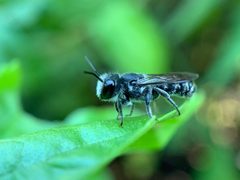
Megachile campanulae, commonly known as the bellflower resin , is a solitary native to eastern North America. Described in 1903, this belongs to the subgenus Chelostomoides, distinguishing it from leafcutting relatives by its use of plant resins, mud, and pebbles rather than cut leaves for nest construction. In 2013, researchers documented this species as one of the first insects known to incorporate synthetic materials, including polyurethane-based sealants, into nest construction. The species is an important of native plants and is nonaggressive toward humans.
Pronunciation
How to pronounce Megachile campanulae: //ˌmɛɡəˈkaɪli kæmˈpæn.jʊli//
These audio files are automatically generated. While they are not always 100% accurate, they are a good starting point.
Identification
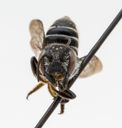
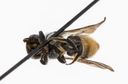
Most closely resembles Megachile angelarum; females can be distinguished by the absence of white banding at the apex of the fifth tergal segment and the parallel-sided metasoma. Males differ from M. angelarum by having fewer punctures between the lateral ocelli and vertex margin, and by the near-absence of the front coxal spine. Distinguished from M. exilis by unmodified front in both sexes (M. exilis males have characteristically dilated and hollowed front tarsal leg segments). Distinguished from leafcutting Megachile by lacking cutting edges. The M. c. wilmingtoni occurs in the southeastern United States and Florida, characterized by larger size, dark on the sixth , and darker wings.
Images
Habitat
Occupies a broad range of across eastern North America. Nests in pre-existing holes in trees, fences, plant stems, and artificial substrates including blocks and nest boxes. In urban environments, has been documented using synthetic materials for nest construction, suggesting adaptability to anthropogenic landscapes. Requires access to plant resins, mud, and pebbles for nest construction, as well as diverse floral resources for pollen and nectar.
Distribution
Native to eastern North America. Range extends from southern Ontario through New England states to Florida, and westward to Minnesota, Nebraska, and Texas. Sparse reports from Colorado and Montana. The M. c. wilmingtoni is restricted to the southeastern coastal United States through Florida, where it becomes the predominant form.
Seasonality
activity typically occurs from April to September across most of the range. In Florida, collected as early as February and as late as November. times in cooler climates generally May–October. Males typically emerge before females.
Diet
Polylectic; larvae are provisioned with pollen mixed with nectar from diverse floral sources. Documented of: Asclepias (milkweed), Baptisia (wild indigo), Campanula (bellflower), Galactia (wild peas), Malva (mallow), Melilotus (sweet-clover), Oenothera (evening primrose), Lobelia, Lythrum (loosestrife), Nepeta (catmints), Pontederia (pickerel weeds), Psoralea (white tumbleweed), Pycnanthemum (mountain mints), Rudbeckia (coneflowers), Solidago (goldenrods), Strophostyles (trailing wild bean), Symphoricarpos (snowberry), and Verbena.
Life Cycle
Solitary nesting with no colony formation. Females construct nests in pre-existing cavities as linear series of individual . Deepest cells are constructed first, with a single laid in each cell. Cells are provisioned with pollen mixed with nectar, then sealed with plant resins, mud, and/or pebbles. Larvae progress through several molting stages, spin cocoons, and pupate. occurs as pupae. emerge after several months; males precede females. Females survive several weeks post- to construct nests and provision cells; males die shortly after mating.
Behavior
Females are solely responsible for nest construction, provisioning, and rearing. Nests are built as single columns of within tubes, with cells partitioned and sealed using resins, mud, and pebbles. In 2013, documented as one of the first insect to use synthetic materials (polyurethane-based sealants, caulk) in nest construction, incorporating plastics into cell walls and sealants. This was observed in urban Toronto and may represent adaptive behavior, with some evidence suggesting reduced in synthetic nests, though also associated with mold growth and potential moisture inhibition. Nonaggressive; can sting but less intensely than honey bees. Pollen is carried on the underside of the (scopa) rather than on hind leg .
Ecological Role
Important of numerous native plant throughout its range. Serves as for including the Monodontomerus obscurus, the kleptoparasitic Stelis louisae, and members of the Coelioxys. Documented use of synthetic nesting materials represents a novel example of behavioral plasticity in response to urban environments, with potential implications for parasite resistance and brood survival.
Human Relevance
Valued as a native of crops and wild plants, particularly significant given declines in managed . Can be managed with minimal equipment using simple boxes or drilled wooden blocks placed in sunny locations. Foraging range approximately 500 yards from nest makes them suitable for small garden enhancement. Nonaggressive nature makes them safe for human proximity. Subject to conservation concerns including exposure, loss, and urbanization effects. The 2013 documentation of synthetic nest material use highlighted this in discussions of pollinator to urban environments.
Similar Taxa
- Megachile angelarumMost similar in overall ; distinguished by females having white banding at apex of fifth tergal segment and non-parallel metasoma, males having approximately twice as many punctures between lateral ocelli and vertex and visible front coxal spines.
- Megachile exilisSimilar appearance; distinguished by males having characteristically dilated and hollowed front tarsal leg segments, which are unmodified in M. campanulae.
- Leafcutting Megachile species (subgenus Megachile s.s.)Often confused due to shared name; distinguished by with cutting edges used to cut leaves for nest construction, versus resin-collecting mandibles without cutting edges in M. campanulae.
More Details
Synthetic Nest Material Use
In 2013, researchers in Toronto documented M. campanulae using synthetic materials including polyurethane-based sealants and caulk to seal nest . Compositional analysis revealed calcium, titanium, and iron. This represented the first known instance of insects actively building nests with plastic rather than merely inhabiting plastic objects. The may be adaptive—some synthetic nests showed reduced —but also carries risks including mold growth, moisture inhibition, and potential toxin exposure.
Subspecies
Two recognized: M. c. campanulae (nominate form) and M. c. wilmingtoni. The latter is larger (11–12 mm), has dark on the sixth , darker wings with brownish tinge, and black scopal hairs at the sixth sternal segment in females. Restricted to southeastern coastal United States and Florida where it becomes predominant.
Sources and further reading
- BugGuide
- Wikipedia
- GBIF taxonomy match
- iNaturalist taxon
- NCBI Taxonomy
- Catalogue of Life
- Looking for Cheap Urban Real Estate | Bug Squad
- In Search of the World's Biggest Bee: How It Came to 'Bee' | Bug Squad
- Photographer Allan Jones Exudes Patience, Skill and Talent | Bug Squad
- The Most Incredible Image of a Leafcutter Bee | Bug Squad
- The Native Bees in the UC Davis Bee Haven | Bug Squad
- Mailbox posts are fine homes for giant resin bees, Megachile sculpturalis — Bug of the Week