
Coelioxys hunteri
Crawford, 1914
Hunter's cuckoo-leaf-cutter bee
Coelioxys hunteri is a of cuckoo leafcutter bee in the Megachilidae. Like other members of the Coelioxys, this species is a that exploits the nest provisions of other bees rather than collecting pollen and nectar itself. The species was described by Crawford in 1914 and occurs in North America and Middle America.
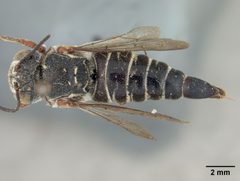
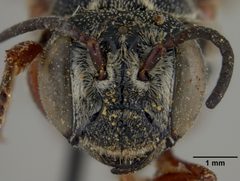
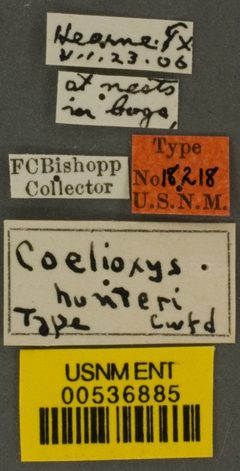
Pronunciation
How to pronounce Coelioxys hunteri: /ˌsiːliˈɒksɪs ˈhʌntəri/
These audio files are automatically generated. While they are not always 100% accurate, they are a good starting point.
Identification
Members of Coelioxys can be distinguished from their leafcutter bees (Megachile) by their slender, -like body form and pointed . Males typically have more extensively modified abdominal tips than females. Specific identification of C. hunteri requires examination of morphological characters such as punctation patterns and genitalia structure.
Images
Distribution
Recorded from North America and Middle America. Specific locality records are limited.
Host Associations
- Megachile - Females deposit in the nest of leafcutter bees; larvae kill the egg or larva and develop on the pollen provisions provided by the host female
Behavior
Cleptoparasitic. Females seek out open nest tunnels of bees, deposit between the leaf pieces lining the host . The resulting larvae are that eliminate the host offspring and consume the stored pollen and nectar.
Ecological Role
Acts as a on leafcutter bees. This parasitic lifestyle represents a natural control mechanism for populations and contributes to dynamics within bee .
Human Relevance
May be observed at hotels or artificial nesting blocks provided for solitary bees. Presence indicates a functioning bee with sufficient .
Similar Taxa
- Coelioxys spp.Other members of the share the cleptoparasitic lifestyle and general body plan; -level identification requires detailed morphological examination
- Nomada spp.Also cleptoparasitic bees, but in Apidae rather than Megachilidae; typically more -like in coloration with yellow and black or red and black patterns
- Megachile spp. leafcutter bees that are exploited by Coelioxys; females collect pollen and leaf pieces to provision their own nests, unlike the parasitic Coelioxys
More Details
Nomenclature
The epithet 'hunteri' honors an individual named Hunter, following standard patronymic convention in zoological .
Taxonomic note
The Coelioxys is part of the tribe Megachilini within Megachilinae, placing it among the most derived lineages of leafcutter-associated bees.