
Dioxys
Lepeletier & Serville, 1825
Species Guides
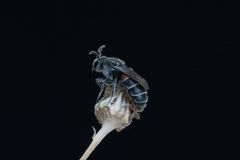
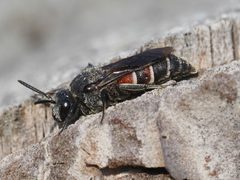
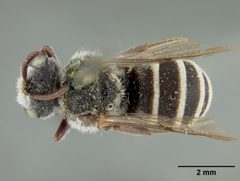
1Dioxys is a of parasitic bees in the Megachilidae, tribe Dioxyini. These bees are characterized by distinctive morphological features including a on the and an extremely reduced, non-functional sting. The genus contains approximately 13 recognized in the West Palaearctic region, with a taxonomic revision published in 2024 resolving several long-standing species-level issues. Dioxys species are distributed across the Mediterranean basin, North Africa, the Middle East, and the Canary Islands, with varying geographic ranges and preferences.
Pronunciation
How to pronounce Dioxys: //daɪˈɒksɪs//
These audio files are automatically generated. While they are not always 100% accurate, they are a good starting point.
Identification
Dioxys can be distinguished from other Megachilidae by the presence of a on the , a diagnostic feature of the tribe Dioxyini. Males are identified primarily by genital capsule characters, which formed the basis for the 2024 taxonomic revision. Females possess an extremely reduced sting, visible as a small non-functional structure. -level identification requires examination of specific morphological traits detailed in the West Palaearctic identification key; for example, D. atlanticus is restricted to the Canary Islands (Gran Canaria and Tenerife only), while D. cypriacus occurs only on Cyprus.
Images
Habitat
varies by : mountainous areas in south-western and central Turkey (D. montanus); western Mediterranean and North Africa (D. rotundatus, D. varipes); Canary Islands (D. atlanticus, D. lanzarotensis); eastern Mediterranean from southern Greece eastwards (D. pumilus); Cyprus (D. cypriacus); Mount Hermon, Israel (D. hermonensis); Morocco and Algeria (D. heinrichi).
Distribution
West Palaearctic region encompassing Europe, Middle East, and North Africa, centered on the Mediterranean basin. Thirteen recognized: D. cinctus (widespread, most commonly encountered), D. rotundatus (western Mediterranean and North Africa to Egypt), D. atlanticus (Gran Canaria and Tenerife only), D. varipes (western Mediterranean to Sicily and Libya), D. pumilus (eastern Mediterranean from southern Greece eastwards, excluding Cyprus), D. cypriacus (Cyprus only), D. hermonensis (Israel: Mount Hermon), D. montanus (mountainous Turkey), D. heinrichi (Morocco and Algeria), D. ardens and D. chalicodus (western Mediterranean, North Africa, Canary Islands), D. rufipes (eastern Mediterranean from Croatia eastwards), D. lanzarotensis (Canary Islands).
Behavior
Parasitic lifestyle; possesses extremely reduced, non-functional sting.
Ecological Role
Parasitic within Megachilidae; specific and ecological interactions not documented.
More Details
Taxonomic revision
A 2024 revision (ZooKeys 1226) resolved major issues in the West Palaearctic fauna: restored D. rotundatus as senior synonym of D. moestus; restricted D. atlanticus to Canary Islands; revalidated D. montanus from synonymy with D. cinctus; split D. pumilus into four (D. pumilus, D. varipes, D. cypriacus, D. hermonensis sp. nov.); and synonymized D. falsificus with D. varipes.