
Megarhyssa nortoni quebecensis
(Provancher, 1873)
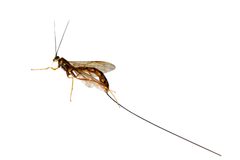
Megarhyssa nortoni quebecensis is a of giant ichneumon wasp, among the largest members of Ichneumonidae in North America. Females possess an extraordinarily long ovipositor—often exceeding body length—that they use to parasitize woodboring larvae of the pigeon horntail (Tremex columba) deep within dead or decaying hardwood. The is harmless to humans, lacking a functional stinger; the apparent "stinger" is actually the ovipositor apparatus. Males are smaller, lack the elongated ovipositor, and exhibit distinctive around potential sites.
Pronunciation
How to pronounce Megarhyssa nortoni quebecensis: //ˌmɛɡəˈraɪsə ˈnɔrtəni ˌkwɛbɛˈsɛnsɪs//
These audio files are automatically generated. While they are not always 100% accurate, they are a good starting point.
Identification
Distinguished from congeneric by coloration and size: M. macrurus males show more brown than black with clear wings and well-developed costal spot, while M. atrata males are larger with more black coloration and smoky wings with narrow costal spot. Females of M. nortoni quebecensis can be separated from M. atrata (all-black body with yellow and forelegs) and M. macrurus by specific pattern elements. The ovipositor apparatus of three visible filaments separates Megarhyssa from other ichneumonids with shorter or single-filament ovipositors. The extremely long ovipositor distinguishes this species group from all other North American ichneumonids.
Images
Appearance
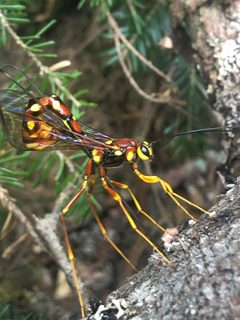
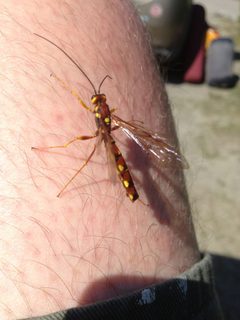
Large ichneumon with slender body. Females possess extremely long, thread-like ovipositor composed of three filaments: two outer that brace the and one central -laying tube. Ovipositor length can reach 130mm, substantially exceeding body length of approximately 38mm. Body coloration includes yellow and black patterning; males typically show more brown coloration with clear wings bearing a well-developed spot on the costal margin, while females have more extensive black markings. Highly elastic intersegmental at abdomen tip allows ovipositor to be deployed or retracted. Males lack the elongated ovipositor entirely and are generally smaller.
Habitat
Deciduous forests with dead, dying, or severely weakened hardwood trees. Specifically associated with wood infested by pigeon horntail (Tremex columba) larvae. Found on cut logs, stumps, and trunks of declining trees—particularly maple and other hardwoods. Requires sufficient wood decay to allow horntail larval development but not so advanced that wood has lost structural integrity needed for oviposition.
Distribution
Native to northeastern and central United States and southeastern Canada. GBIF records indicate presence in Alberta (Calgary, Lethbridge, Waterton, George L), British Columbia, and Santa Catarina, Brazil (likely introduced or erroneous record). The subspecific epithet "quebecensis" indicates type locality in Quebec. Introduced to New Zealand after 1962 as agent for Sirex noctilio.
Seasonality
active during summer months, with peak activity in June and July in northern parts of range. Females observed ovipositing throughout daylight hours. Males aggregate at sites where females are expected to emerge. No specific data available for this versus nominate form.
Host Associations
- Tremex columba - pigeon horntail; larval ichneumon attaches to exterior of horntail , waits for to reach near-mature size, then consumes it
- Sirex noctilio - introduced in New Zealand; intentional introduction
Life Cycle
Female locates horntail within wood using unknown mechanism—possibly detection of fungal odors or vibrational cues. Arches to position ovipositor perpendicular to wood surface, then drills into solid wood to deliver nearly fluid onto grub. Ovipositor may penetrate wood directly or follow existing cracks. Larva hatches and attaches externally to host, remaining until host nears maturity, then consumes it. occurs within wood; emerges by chewing exit hole. Adult lifespan approximately one month; does not feed as adult (energy derived from larval fat reserves).
Behavior
Females exhibit remarkable wood-drilling oviposition , sometimes remaining stationary for extended periods while ovipositor is inserted. Vulnerable to during oviposition; hair-like ovipositor fragments may remain protruding from wood if female is captured by . Males aggregate at potential sites, performing "tergal stroking"—bending forward to rub tip against bark and inserting abdomen tip into cracks. This behavior appears related to detecting or discriminating emerging females, though precise function remains unknown. Both sexes shy and easily startled by sudden movement.
Ecological Role
Primary regulating of woodboring horntail . By parasitizing horntail larvae, indirectly influences decomposition dynamics of dead hardwoods. Multiple Megarhyssa may coexist at same site through resource partitioning by ovipositor length—larger species reach deeper horntail larvae, smaller species utilize shallower tunnels.
Human Relevance
Harmless to humans; cannot sting despite intimidating appearance. Frequently causes alarm due to large size and whip-like ovipositor. Subject of intentional introduction to New Zealand for of Sirex noctilio woodwasp. Occasionally encountered in residential areas when dead trees or stumps present. Featured in popular entomology literature and photography due to spectacular and .
Similar Taxa
- Megarhyssa macrurusOverlapping range and use; males distinguished by smaller size, more brown coloration, clear wings with well-developed costal spot; females by color pattern differences
- Megarhyssa atrataOverlapping range; males larger with more black coloration and smoky wings with narrow costal spot; females all-black body with yellow and forelegs, versus patterned coloration in M. nortoni
- Tremex columbaFrequently confused by observers; pigeon horntail is with shorter, thicker ovipositor used for its own wood-drilling -laying, not the extremely elongated parasitic ovipositor of Megarhyssa
Misconceptions
Widely mistaken for dangerous stinging due to long, needle-like ovipositor. The ovipositor cannot deliver venom and is used solely for -laying; these wasps are entirely stingless. Another misconception is that they damage healthy trees—they only parasitize horntail larvae already present in dead, dying, or decaying wood, and do not initiate woodboring themselves.
More Details
Ovipositor mechanics
The ovipositor apparatus consists of two outer valvulae that form a protective and brace the , plus the central -laying tube. A highly elastic intersegmental at the abdomen tip permits the extreme contortions necessary for drilling while allowing the ovipositor to trail behind when not in use. The may secrete cellulase to facilitate wood penetration, though this remains uncertain.
Male aggregation behavior
Males gather at sites where females will emerge, sometimes in large numbers. The function of tergal stroking and abdominal insertion into bark cracks appears related to detecting virgin females or enabling sex discrimination of emerging , but this remains incompletely understood.