
Polytribax
Förster, 1869
Species Guides
2Polytribax is a of ichneumonid wasps in the Cryptinae containing approximately 15 described . Members are of Lepidoptera pupae, with females adapted for ground-level foraging in leaf litter and soil. The genus exhibits strong , particularly pronounced in Polytribax perspicillator. Species are distributed across the Western Palaearctic with records extending to the Oriental and Nearctic realms.
Pronunciation
How to pronounce Polytribax: /pɔˌlɪˈtrɪbæks/
These audio files are automatically generated. While they are not always 100% accurate, they are a good starting point.
Identification
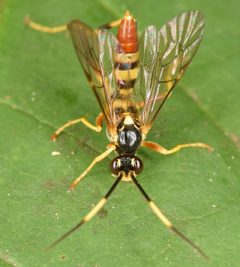
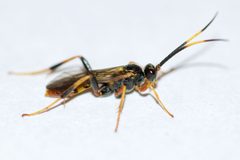
Polytribax can be recognized within Cryptinae by their robust, compact female with stout legs and adapted for pushing through substrate. Males are slender with conspicuous white markings, particularly on the hind . Females are typically black and reddish, while males often display brighter coloration. These traits distinguish them from more gracile Cryptinae lacking such pronounced and substrate-specialized morphology.
Images
Habitat
Deciduous woodland; low vegetation; leaf litter and soil at ground level. Females spend most time at ground level pushing through leaf litter and soil to reach , while males are often spotted in low vegetation.
Distribution
Western Palaearctic; records across the Palaearctic, Oriental and Nearctic realms extending as far south as India and Mexico. Confirmed country records include Denmark, Norway, and Sweden.
Seasonality
Active from May to August in Britain; specific seasonality for other regions not documented.
Host Associations
- Lepidoptera pupae concealed in leaf litter or soil - range poorly understood; few reliable host records for any Polytribax
- Lycaenidae - Lycaenid pupae recorded as for two Polytribax , not specifically P. perspicillator
Behavior
Strong in and : females are ground-oriented, pushing through leaf litter and soil to locate ; males are more commonly observed in low vegetation.
Ecological Role
of Lepidoptera pupae concealed in leaf litter or soil; contributes to regulation of ground-dwelling Lepidoptera in woodland .
Similar Taxa
- Other Cryptinae generaPolytribax is distinguished by pronounced and female adaptations (stout legs, compact body) for substrate foraging not typical of more gracile Cryptinae
- Ichneumonidae: Cryptinae placement based on morphological traits; -level identification requires examination of patterns and female leg/ structure