
Aleiodes terminalis
Cresson, 1869
Terminal Mummy Wasp
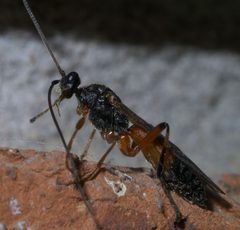
Aleiodes terminalis is a of mummy in the Braconidae, first described by Cresson in 1869. Like other members of the Aleiodes, it is a koinobiont endoparasitoid that develops inside living caterpillar . The species is part of a diverse radiation of Aleiodes wasps that exhibit the distinctive trait of causing host caterpillars to mummify after the wasp larva emerges. It is one of the earlier-described species in a genus that has seen extensive taxonomic revision and species discovery in recent decades.
Pronunciation
How to pronounce Aleiodes terminalis: /æl.iˈoʊ.diːz tərˈmɪ.nə.lɪs/
These audio files are automatically generated. While they are not always 100% accurate, they are a good starting point.
Images
Diet
Larvae are endoparasitoids of caterpillars, feeding on tissues from within the living host.
Host Associations
- Caterpillars - larval specific unknown
Life Cycle
Females deposit into caterpillar . Larvae develop internally, eventually killing the host and causing it to mummify. emerge from the mummified host remains.
Behavior
Females seek out caterpillar for oviposition. Larvae induce characteristic host mummification typical of the .
Ecological Role
Acts as a agent by parasitizing caterpillar , potentially regulating herbivorous lepidopteran densities in native .
Similar Taxa
- Other Aleiodes speciesDistinguished by specific morphological features of the mesosoma, wing venation, and coloration patterns; precise identification requires examination of and diagnostic keys.
More Details
Taxonomic note
The Aleiodes has undergone extensive revision, with many new described from tropical regions in the 2010s. Aleiodes terminalis, as an older species description (1869), requires careful comparison with modern descriptions to confirm identity of specimens.