
Charmon
Haliday, 1833
Species Guides
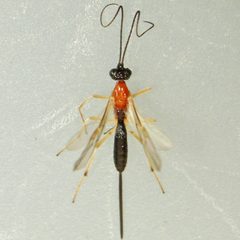
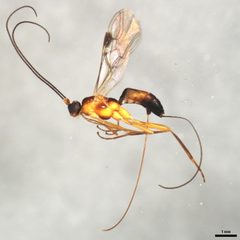
2Charmon is a of in the Braconidae, Charmontinae, established by Haliday in 1833. The genus comprises 10 recognized with a predominantly Holarctic distribution, though recent records extend its range to Southeast Asia. Charmon thailandensis, described from Doi Phu Kha National Park in Thailand, represents the first documented occurrence of the genus in Southeast Asia. barcode data suggest that morphologically similar species may not be closely related, indicating potential cryptic diversity within the genus.
Pronunciation
How to pronounce Charmon: //ˈkɑɹ.mɒn//
These audio files are automatically generated. While they are not always 100% accurate, they are a good starting point.
Identification
Identification to level in Charmon requires examination of morphological characters combined with barcode (COI) sequence data, as morphological similarity does not reliably indicate phylogenetic relationships. The can be distinguished from other braconid genera by characteristics of the Charmontinae, though specific diagnostic features for Charmon itself are not detailed in available sources.
Images
Habitat
Recorded from montane forest at Doi Phu Kha National Park, Nan Province, Thailand, at elevations typical of northern Thai mountain ranges. Additional distributional records suggest occupancy of temperate and regions in Europe and Scandinavia.
Distribution
Documented from Europe (Denmark, Norway, Sweden) and Southeast Asia (Thailand). The Thai record from Doi Phu Kha National Park represents the first confirmed occurrence of the in Southeast Asia.
Ecological Role
As members of Braconidae, in this are presumed to function as , though specific relationships remain undocumented in available sources.
Similar Taxa
- C. extensorMorphologically similar to C. thailandensis; however, data indicate C. thailandensis occupies a basal position relative to other sequenced Charmon , suggesting convergent or retained plesiomorphic traits. C. extensor itself may represent a rather than a single biological species.
More Details
Phylogenetic Uncertainty
barcode (COI) data for C. thailandensis indicate it is quite basal with respect to all other sequenced Charmon , despite morphological resemblance to C. extensor. This discrepancy highlights the importance of molecular data for species delimitation in this .
Species Diversity
Ten are currently recognized in Charmon, though the possibility that C. extensor represents a complex of more than one species suggests that actual diversity may be underestimated.