
Phaenocarpa
Förster, 1862
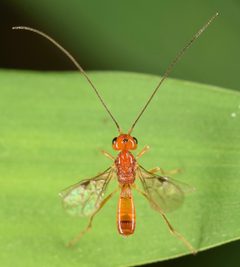
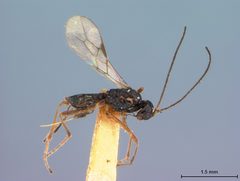
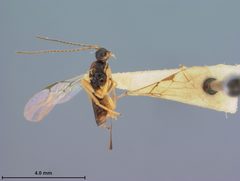
Phaenocarpa is a of koinobiont endoparasitoid in the Braconidae ( Alysiinae, tribe Alysiini). are known to parasitize dipteran larvae, with documented including families Anthomyiidae, Chloropidae, Clusiidae, Drosophilidae, Muscidae, Scathophagidae, Sciomyzidae, and Syrphidae. emerge from host using specialized exodont teeth. The genus has distribution with records from Europe, Asia, and Australia, and has been studied for potential applications against pest flies.
Pronunciation
How to pronounce Phaenocarpa: //ˌfiːnoʊˈkɑːrpə//
These audio files are automatically generated. While they are not always 100% accurate, they are a good starting point.
Identification
Members of Phaenocarpa can be distinguished from related alysiine by features of the structure, including the presence of 2-7 exodont teeth used for from . -level identification relies on characters such as ovipositor length (0.8-1.9× hind tibia length), mandibular tooth number and curvature, and body pilosity. Identification keys are available for regional faunas including South Korea and Finland.
Images
Habitat
have been collected in mountain forests ( at elevations including Mt. Odaesan, Mt. Kalbong, Gwaneumsa Temple in South Korea) and coastal sand dunes (Kalajoki, Finland). Specific microhabitat associations relate to fly larval rather than preferences.
Distribution
. Documented from Europe (Finland, Norway, Estonia, Denmark, Sweden), Asia (South Korea, Mongolia, Kamchatka), and Australia. GBIF records confirm presence in Denmark, Norway, and Sweden.
Host Associations
- Anthomyiidae (Diptera) - larval cited from Wharton 1984 and van Achterberg 1998, 2009
- Chloropidae (Diptera) - larval cited from Wharton 1984 and van Achterberg 1998, 2009
- Clusiidae (Diptera) - larval cited from Wharton 1984 and van Achterberg 1998, 2009
- Drosophilidae (Diptera) - larval P. persimilis specifically parasitizes Drosophila
- Muscidae (Diptera) - larval cited from Wharton 1984 and van Achterberg 1998, 2009
- Scathophagidae (Diptera) - larval cited from Wharton 1984 and van Achterberg 1998, 2009
- Sciomyzidae (Diptera) - larval cited from Wharton 1984 and van Achterberg 1998, 2009
- Syrphidae (Diptera) - larval cited from Wharton 1984 and van Achterberg 1998, 2009
Life Cycle
Koinobiont endoparasitoid: laid in larva, develops internally while host continues feeding and growing, emerges from host . facilitated by exodont teeth (2-7 teeth) that are outwardly curved or straight, used to break through puparial wall.
Behavior
use specialized mandibular teeth to emerge from . The mandibular structure represents a key behavioral for escaping the enclosed puparial environment.
Ecological Role
agent. Several Alysiinae have been utilized for control of agricultural pests including Liriomyza trifolii (Agromyzidae) and Drosophila suzukii (Drosophilidae); Phaenocarpa persimilis has been evaluated for potential against Drosophila pests.
Human Relevance
Studied for potential against pestiferous flies, particularly Drosophila . Research has focused on laboratory rearing methods and as a .
Similar Taxa
- Other Alysiinae generaDistinguished by mandibular tooth structure and number; Phaenocarpa specifically characterized by exodont teeth used for puparial .
More Details
Taxonomic subdivisions
The includes subgeneric divisions: Phaenocarpa (Phaenocarpa) and P. (Discphaenocarpa). described in recent taxonomic work include P. acutidentata, P. angusticeps, P. hirsuta, P. persimilis, P. picinervis, P. setosa, P. tacita, P. tacitoides, P. tanycauda from various geographic regions.
Molecular data
COI barcode analysis has been conducted for phylogenetic relationships among Korean .
Sources and further reading
- BugGuide
- GBIF taxonomy match
- iNaturalist taxon
- NCBI Taxonomy
- Catalogue of Life
- Laboratory Biology of Phaenocarpa Persimilis Papp (Braconidae: Alysiinae), a Parasitoid of Drosophila.
- <i>Phaenocarpa hirsuta</i> sp. n., <i>P. picinervis</i> (Haliday) and <i>P. angustiptera</i> Papp new to the fauna of Finland (Hymenoptera: Braconidae: Alysiinae)
- Five new species and one new record of the genus Phaenocarpa Foerster (Hymenoptera, Braconidae, Alysiinae) from South Korea.