
Sphecodes davisii
Robertson, 1897
Davis's Cuckoo Sweat Bee
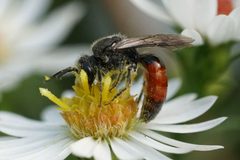
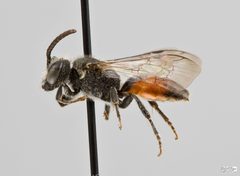
Sphecodes davisii is a cleptoparasitic sweat bee in the Halictidae. As a member of the Sphecodes, it exhibits the cuckoo bee lifestyle: females enter nests of sweat bees to lay in , where their larvae consume the host's provisions and developing young. The is native to North America, with documented records from Vermont and broader North American distribution. Like other Sphecodes, it likely targets ground-nesting Halictidae as hosts.
Pronunciation
How to pronounce Sphecodes davisii: /ˈsfɛkoʊdiːz ˈdeɪvɪsi.aɪ/
These audio files are automatically generated. While they are not always 100% accurate, they are a good starting point.
Identification
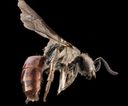
Sphecodes are distinguished from other Halictidae by their slender, -like build with a constricted waist, reduced scopal hairs (pollen-carrying structures) since they do not collect provisions, and typically red and black coloration. Specific identification of S. davisii requires examination of morphological details such as punctation , wing venation, and male genitalia; it may be distinguished from by subtle differences in abdominal banding patterns and facial markings. They are often mistaken for wasps or Nomad bees (Nomada) due to their similar appearance and parasitic habits.
Images
Habitat
Associated with supporting its , which are ground-nesting sweat bees. Found in areas with suitable soil substrates for host nesting, including meadows, open woodlands, and disturbed ground. The UC Davis Haven documentation of Sphecodes sp. notes females waiting at nest entrances, indicating proximity to active host colonies.
Distribution
North America; documented from Vermont, United States, with broader distribution across the continent inferred from GBIF records.
Host Associations
- Halictidae - Sphecodes are of ground-nesting sweat bees; specific records for S. davisii are not documented in available sources, but -level association with Halictus and other Halictinae is established
Life Cycle
Cleptoparasitic: females locate nests, enter during host absence, and deposit in . Larvae hatch and consume host provisions, then parasitize host larvae. Development completes within the host nest, with emerging the following season.
Behavior
Females exhibit nest-searching , hovering low to ground to detect nest entrances. Documented behavior includes waiting at nest entrances for host departure before entering to oviposit. Some Sphecodes use force to enter occupied nests, though specific behavioral details for S. davisii are not separately documented.
Ecological Role
Acts as a regulator of sweat bee through . Contributes to dynamics and may influence nesting patterns of hosts.
Human Relevance
Minimal direct economic impact; contributes to understanding of and - relationships. Observed in gardens and research settings such as the UC Davis Bee Haven.
Similar Taxa
- NomadaSimilar -like appearance, slender waist, and cleptoparasitic lifestyle; distinguished by different antennal structure and wing venation
- TriepeolusAnother cleptoparasitic with convergent ; differs in associations (typically Anthophorini) and subtle morphological characters
- Sphecodes albilabrisCongeneric with similar and appearance; distinguished by geographic range and morphological details not resolved in available sources
More Details
Taxonomic note
Described by Robertson in 1897; the specific epithet honors an individual named Davis. The Sphecodes contains approximately 300 globally, with numerous North American representatives.