
Lasioglossum texanum
(Cresson, 1872)
Nocturnal Sweat Bee, Texas Sweat Bee
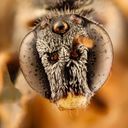
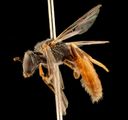
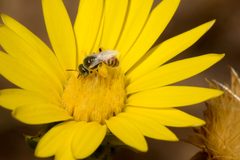
Lasioglossum texanum is a sweat ( Halictidae) notable for its unusual foraging . Unlike most bees, it actively collects pollen during evening hours and continues after dark until approximately 10:00 PM when moonlight is available. It is a ground-nesting solitary bee with highly specialized pollen preferences, foraging exclusively from flowers of the four-point evening-primrose (Oenothera rhombipetala).
Pronunciation
How to pronounce Lasioglossum texanum: //ˌlæsi.oʊˈɡlɔsəm tɛkˈsænəm//
These audio files are automatically generated. While they are not always 100% accurate, they are a good starting point.
Identification
May be distinguished from other Lasioglossum by its documented foraging ; most congenes are strictly . Specific morphological diagnostic features are not provided in available sources. Identification to species level likely requires examination of microscopic characters typical of the , including genitalia and wing venation patterns.
Images
Habitat
Ground-nesting inhabiting areas where its plant Oenothera rhombipetala occurs. Specific requirements beyond host plant association are not documented.
Distribution
Recorded from Middle America and North America. Specific range boundaries within these regions are not detailed in available sources.
Diet
females collect pollen exclusively from Oenothera rhombipetala (four-point evening-primrose). Nectar sources are not specified. Adults of both sexes have been observed lapping human sweat for salts and minerals.
Host Associations
- Oenothera rhombipetala - Pollen sourceExclusive pollen source; sole documented plant
Life Cycle
Ground-nesting solitary . Females excavate burrows in soil. Detailed description of developmental stages, provisioning , and are not documented in available sources.
Behavior
Exhibits strongly foraging, flying to collect pollen in evening and continuing after dark until approximately 10:00 PM when moonlight is present. This represents a significant departure from typical activity patterns in bees. , particularly females, frequently land on humans to lap sweat from skin.
Ecological Role
of Oenothera rhombipetala. Its activity pattern suggests potential role in pollination during periods when most other pollinators are inactive, though this specific ecological function has not been quantified.
Human Relevance
Attracted to human perspiration; may land on skin to obtain salts and minerals. Sting is generally mild but can cause localized pain and swelling in sensitive individuals. Not known to be agriculturally significant due to extreme specialization.
Similar Taxa
- Other Lasioglossum speciesMost congenes are ; L. texanum distinguished by documented pollen collection
- Other HalictidaeShares -level traits of small size and ground-nesting, but foraging is atypical for the family
More Details
Activity pattern
One of relatively few documented to forage at night, representing an evolutionary convergence with other such as
Foraging specialization
Extreme oligophagy—pollen collection restricted to single plant —is uncommon among bees and suggests tight ecological with Oenothera rhombipetala
Sources and further reading
- BugGuide
- Wikipedia
- GBIF taxonomy match
- iNaturalist taxon
- Catalogue of Life
- Just inTime for Pollinator Week | Bug Squad
- Bug Eric: Don't Sweat 'em
- Back-Seat Driver: The Parasite That Makes Bees Drop Off Its Babies
- Building a Better Bee Trap: Researchers Say Bee Bowls Are Overused
- Bug Eric: White Prairie Clover: An Awesome Blossom
- Not-so Solitary Bees - Buglife Blog - Buglife