
Halictus parallelus
Say, 1837
Parallel-striped Sweat Bee
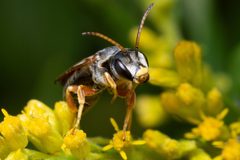
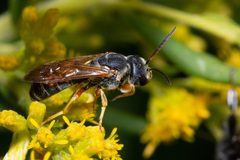
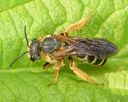
Halictus parallelus is a of sweat bee in the Halictidae, native to North America. The refers to the distinctive parallel pale bands across the . Like other halictids, this species is a ground-nesting that provisions its burrows with pollen and nectar for its young.
Pronunciation
How to pronounce Halictus parallelus: /həˈlɪktəs ˌpɛrəˈlɛləs/
These audio files are automatically generated. While they are not always 100% accurate, they are a good starting point.
Identification
Distinguished from other Halictus by the parallel (rather than interrupted or wavy) pale bands across the abdominal tergites. Medium-sized with brown or blackish coloration and white transverse bands. Members of Halictus are generally larger than the tiny metallic Lasioglossum sweat bees and less brilliantly colored than the green Agapostemon species.
Images
Distribution
North America; recorded from Vermont and other regions of the United States.
Ecological Role
. As a forager, visits a variety of flowering plants to collect nectar and pollen.
Human Relevance
Contributes to pollination of wild plants and potentially crops. May occasionally land on humans to obtain salts from perspiration, as is characteristic of sweat bees (Halictidae), but is harmless unless handled roughly.
Similar Taxa
- Halictus ligatusSimilar size and banded abdominal pattern, but H. ligatus typically has more irregular or less perfectly parallel bands and exhibits eusocial in some .
- Halictus poeyiVery similar appearance and often occurs in the same ; distinguished by subtle differences in banding pattern and geographic distribution.
- Lasioglossum speciesOften confused due to shared 'sweat bee,' but Lasiogostemon are generally much smaller, often metallic, and lack the distinct parallel pale bands on .
- Agapostemon speciesBoth are called 'sweat bees' and in Halictidae, but Agapostemon are typically bright metallic green or blue with less prominent abdominal banding.
Sources and further reading
- BugGuide
- Wikipedia
- GBIF taxonomy match
- iNaturalist taxon
- NCBI Taxonomy
- Catalogue of Life
- Are Honeybees the Most Effective Pollinators? | Bug Squad
- 'Bee' One in a Million | Bug Squad
- Sweet times for sweat bees: Sweat bees, Halictus ligatus and Agapostemon virescens — Bug of the Week
- Ground nesting bees, beware the bee fly: Bombyliidae — Bug of the Week
- Bug Eric: Don't Sweat 'em
- “62nd” Annual “Season-Opener-Birthday-Bug-Collecting-Trip” | Beetles In The Bush