
Pseudomyrmex simplex
(Smith, 1877)
Simple Twig Ant
Pseudomyrmex simplex is a Neotropical in the twig ant Pseudomyrmex, characterized by its slender, -like body form and notably large . The species inhabits tropical and subtropical regions of South America, where it forages arboreally on vegetation. Like other members of its genus, it exhibits an elongate adapted for life among branches and twigs rather than ground-dwelling.
Pronunciation
How to pronounce Pseudomyrmex simplex: /ˌpsɛu.doˈmɪrmɛks ˈsɪmplɛks/
These audio files are automatically generated. While they are not always 100% accurate, they are a good starting point.
Identification
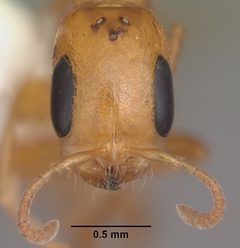
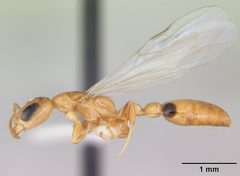
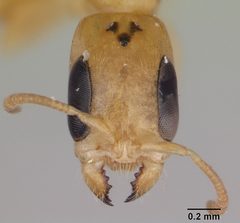
Difficult to distinguish from other small, yellow-orange Pseudomyrmex without specimen examination and taxonomic keys. The is characterized by large , slender petiole, and elongate body form, but species-level identification requires detailed morphological analysis. Distinguished from the larger and hairier P. gracilis by smaller size and reduced pilosity. Petiole shape differs from P. phyllophilus.
Images
Appearance
Slender, elongate body with a -like profile. Large, prominent that are conspicuous relative to size. Coloration typically orangish to yellowish. Body form adapted for arboreal movement with long legs relative to body size.
Habitat
Arboreal including trees, shrubs, and palm trunks. Found in tropical and subtropical vegetation, particularly along riverbanks and in wooded areas. Associated with branches and twigs rather than ground-dwelling.
Distribution
Neotropical distribution with records from Brazil (Acre, Amazonas, Bahia, Ceará, Distrito Federal, Goiás, Minas Gerais, Mato Grosso do Sul, Pará, Paraíba, Paraná, Rio de Janeiro, Rondônia, São Paulo), Colombia (Montería, Villavicencio), and San Andrés y Providencia. The occurs throughout the Neotropics with highest diversity in Central and South America.
Seasonality
Active year-round in tropical , with continuous activity unlike many insects that restrict to moist seasons. Observed active in early April (early autumn) in subtropical Argentina, indicating of seasonally dry conditions.
Behavior
Rapid, continuous movement while foraging on vegetation. Tenaciously crawls along twigs and branches, frequently moving to the opposite side of substrates when disturbed. Arboreal foraging strategy with frenetic, unceasing activity that makes photography challenging.
Similar Taxa
- Pseudomyrmex flavidulusSimilar small size and yellow-orange coloration; distinguished by subtle morphological differences requiring expert identification
- Pseudomyrmex gracilisLarger (10 mm+ vs. 4-7 mm), hairier, with differently shaped petiole; P. simplex is smaller and less pilose
- Pseudomyrmex phyllophilusSimilar overall appearance but differs in petiole shape and pilosity; P. simplex has reduced hair coverage
More Details
Taxonomic complexity
The Pseudomyrmex contains over 200 described with numerous cryptic . P. simplex and related small yellow species may represent unresolved species boundaries requiring further taxonomic study.
Photographic challenges
The combination of rapid movement, tendency to hide on the far side of twigs, and thorny vegetation makes this particularly difficult to photograph well. Successful images typically require tracking shots rather than waiting for pauses.
Sources and further reading
- BugGuide
- Wikipedia
- GBIF taxonomy match
- iNaturalist taxon
- NCBI Taxonomy
- Catalogue of Life
- The bodyguard: Pseudomyrmex ants protecting bullhorn acacias — Bug of the Week
- Pseudomyrmex in Corrientes, Argentina | Beetles In The Bush
- Rainforest Ants 3 – The Bodyguards, part 1: Pseudomyrmex ants protecting bullhorn acacias — Bug of the Week
- Bichos Argentinos #2 – Pseudomyrmex sp. | Beetles In The Bush