
Brachyponera
Emery, 1900
Asian needle ants
Species Guides
1- Brachyponera chinensis(Asian needle ant)
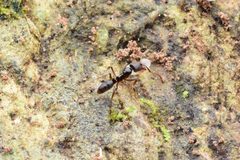
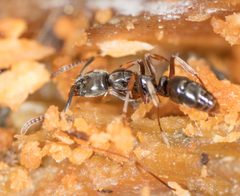
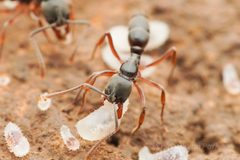
Brachyponera is a of ponerine ants established by Emery in 1900, originally as a subgenus of Euponera. The genus comprises small to medium-sized ants (3–7 mm) with triangular , native to Africa, southern Asia, and Australia, with highest diversity in Southeast Asia. Several have become , notably B. chinensis (Asian needle ) in the eastern United States and New Zealand, and B. sennaarensis (samsum ant) throughout the Middle East. These are significant public health concerns due to severely painful stings capable of causing fatal anaphylactic shock.
Pronunciation
How to pronounce Brachyponera: /brəˌkɪpoʊˈnɪərə/
These audio files are automatically generated. While they are not always 100% accurate, they are a good starting point.
Identification
Distinguished from related by triangular and small to medium size (3–7 mm). Queens are winged and larger than workers, unlike some ponerine genera where -worker differentiation is less pronounced. Separation from the former genus Pachycondyla (from which some were transferred) requires examination of mandibular shape and other morphological characters detailed in Schmidt and Shattuck (2014).
Images
Appearance
Habitat
Native occupy diverse across tropical and subtropical regions. populations of B. chinensis occupy both urban and natural forested habitats in the eastern United States. B. sennaarensis nests in moist areas, cracks in cemented structures, under organic wastes, leaves, wooded and grassed fields, under porous stones or logs (especially -inhabited logs), and in urban areas including streets, houses, hospitals, irrigated parks, gardens, farms, and semi-desert surrounding areas. B. nigrita in Pakistan occupies areas with specific temperature and precipitation regimes, with distribution limited by altitude in some regions.
Distribution
Native range extends from Africa through southern Asia to Australia, with most occurring in Southeast Asia. Specific records include: sub-Saharan Africa (B. sennaarensis: Sudan, Congo, Guinea, Ethiopia, Nigeria, Senegal, Zaire, Cameroon, Somalia, Niger); Southeast Asia (B. obscurans: Sri Lanka, Myanmar, Thailand, Malaysia, Indonesia; B. nigrita: Pakistan Pothwar region, with modeled future expansion); Japan (B. chinensis, B. nakasujii); southern India (Tamil Nadu, Kolli Hills). range: B. chinensis in southeastern United States (North to Rhode Island), New Zealand; B. sennaarensis in Saudi Arabia, Oman, Yemen, Kuwait, United Arab Emirates, Bahrain, Qatar, Iran. Absent from high-altitude regions above 2000–3000 m in Saudi Arabia.
Seasonality
B. sennaarensis shows peak activity in spring and summer, with reduced activity in autumn and winter; foraging commences one hour before sunset and continues until midnight during warm weather. B. nakasujii in Japan shows seasonal changes in and numbers per nest. B. chinensis activity patterns vary by region; in US , active during warmer months.
Diet
exhibit flexible feeding strategies. B. sennaarensis is granivorous and predatory on small prey, with similar to scavenging; limited to small prey items. B. chinensis is a , with subterranean termites as an important nutritional resource; studies demonstrate strong attraction to termite cuticular extracts and (Z)-9-pentacosene. B. nigrita is associated with termites, collembolans, and larval stages of different insects. B. luteipes hunts termites (Reticulitermes qingdaoensis) using specific techniques.
Host Associations
- termites - preyB. chinensis is a ; B. sennaarensis nests in termite-inhabited logs; B. luteipes and B. nigrita also associated with termites
- collembolans - preyB. nigrita associated with collembolans
- Ponerotilla spp. (Mutillidae) - commensal or parasiticFour of velvet ants (P. incarinata, P. lissantyx, P. clarki, P. lamelligera) collected from nests of or in association with B. lutea in Western Australia
Life Cycle
Colonies contain , males, and queens (all cast types observed). Functional occurs in B. chinensis and B. nakasujii across seasons. B. sennaarensis colonies excavated to 50–100 cm depth required digging 30–50 cm around nest orifices. Males present in large B. sennaarensis colonies during spring and summer. White and creamy white pupae observed in B. nigrita. B. chinensis exhibits inbreeding through sib-mating (sister queens and brothers) as a pre-adapted trait; this is not a post-introduction but exists in native .
Behavior
Foraging varies by and colony condition: B. sennaarensis forage individually, using light cues, chemical graduated marking near nest entrance, and memory to return to nests; recruitment observed during nest-moving; in starved colonies, prey introduction triggers massive exit of foragers (primitive mass recruitment), while well-fed colonies show individual repeated trips without recruitment. B. chinensis and B. luteipes exhibit hunting techniques. B. luteipes shows aggressive with B. chinensis, gaining advantage in conflicts, but avoids Pheidole nodus soldiers. B. chinensis exhibits weak internest aggression and high acceptance of non-nestmates in native Japanese —traits shared with ants. Nest in B. chinensis involves organized division of labor: -tending, -tending, and scouting groups form before recruitment; scout ants physically transport nestmates to new harborage, with transport rates increasing over time and differing for brood versus .
Ecological Role
Predatory ants, with several functioning as . cause considerable damage to natural : B. chinensis negatively impacts native ecosystems in the eastern US; B. sennaarensis considered potential competitor with other fauna that may affect ant diversity. B. chinensis may compete with native ant species. B. luteipes participates in with other ants. Climate change may expand suitable for some species (B. nigrita in Pakistan projected to increase distribution area by 2050 under RCP 4.5 and RCP 8.5 scenarios).
Human Relevance
Significant public health and economic impacts from . B. sennaarensis (samsum ) has a severely painful and medically significant sting capable of causing fatal anaphylactic shock; considered a public health hazard and social nuisance in the Middle East; venom has demonstrated anti-inflammatory and anti-cancer properties in laboratory studies. B. chinensis (Asian needle ant) is a growing pest in the eastern US with negative impacts on native and human health; control strategies are being developed using cuticular extracts to improve efficacy, with field trials showing 98% reduction within 14 days. B. chinensis has expanded to Rhode Island, representing the northernmost record in New England.
Similar Taxa
- PachycondylaSome Brachyponera were formerly classified in Pachycondyla; distinguished by mandibular and other characters per Schmidt and Shattuck (2014)
- EuponeraBrachyponera was originally established as a subgenus of Euponera; now recognized as distinct
- PheidoleB. luteipes avoids Pheidole nodus soldiers, suggesting ecological overlap and potential competition; morphologically distinguished by in Brachyponera versus dimorphic worker in Pheidole
More Details
Taxonomic history
Established as subgenus of Euponera by Emery (1900) with description of B. croceicornis; elevated to status. transferred from Pachycondyla to Brachyponera per Schmidt and Shattuck (2014).
Invasion biology
B. chinensis possesses pre-adapted traits for invasion success: inbreeding through sib-mating in native , functional , weak internest aggression, and acceptance of non-nestmates. These characteristics allow circumvention of genetic bottleneck costs typically associated with biological invasions.
Control research
B. chinensis control improved by augmenting baits with cuticular extract or synthetic (Z)-9-pentacosene, significantly increasing acceptance and foraging activity, with faster control compared to standard bait.
Sources and further reading
- BugGuide
- Wikipedia
- GBIF taxonomy match
- iNaturalist taxon
- NCBI Taxonomy
- Catalogue of Life
- Reactions Of Brachyponera Luteipes to Contacts with Different Social Insects
- First Record of Brachyponera obscurans (Walker, 1859) (Hymenoptera-Formicidae) from Southern India
- Samsum ant, Brachyponera sennaarensis (Formicidae: Ponerinae): Distribution and abundance in Saudi Arabia
- Predatory behavior of a seed‐eating ant: Brachyponera senaarensis
- Nest Emigration Behavior of the Asian Needle Ant, Brachyponera (=Pachycondyla) chinensis Emery (Hymenoptera: Formicidae)
- Termite cuticular extracts improve acceptance of bait for controlling invasive Asian needle ants, Brachyponera chinensis
- A New Genus and Four New Species of Mutillidae Associated withBrachyponera luteaMayr (Formicidae) in Western Australia (Hymenoptera)
- Modeling potential distribution of newly recorded ant, Brachyponera nigrita using Maxent under climate change in Pothwar region, Pakistan
- Social structure and nestmate discrimination in two species of Brachyponera ants distributed in Japan
- Survey of ants (Hymenoptera, Formicidae) in the city of Providence (Rhode Island, United States) and a new northern-most record for Brachyponera chinensis (Emery, 1895)
- Forecasting the Future of Brachyponera sennaarensis (Mayr, 1862) (Hymenoptera: Formicidae). Climate Change, Habitat Degradation, and Management Implications throughout Africa and the Middle East
- Inbreeding tolerance as a pre‐adapted trait for invasion success in the invasive ant Brachyponera chinensis