
Monomorium ergatogyna
Wheeler, 1904
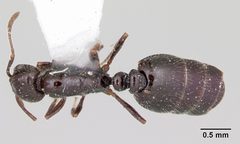
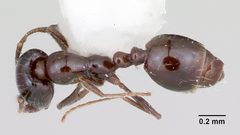
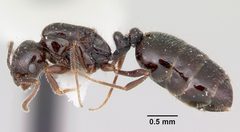
Monomorium ergatogyna is a shiny black myrmicine native to the southwestern United States. It is , possessing only a single , and polygynous with multiple fertile queens coexisting in colonies. The is notable for having exceptionally long-lived queens compared to other Monomorium species, with documented lifespans up to 2 years in captivity. It is frequently found in urban environments and coastal areas, and is currently experiencing competitive displacement by the Argentine ant (Linepithema humile).
Pronunciation
How to pronounce Monomorium ergatogyna: /ˌmɒnəˈmɔːriəm ˌɛrɡətoʊˈdʒaɪnə/
These audio files are automatically generated. While they are not always 100% accurate, they are a good starting point.
Identification
Distinguished from similar Monomorium by its and shiny black coloration. Most commonly confused with Monomorium carbonarium, from which it is difficult to separate based on external alone. Examination of colony structure ( with multiple queens) and context may aid identification. The island and mainland California show size differences, though whether these represent distinct is disputed.
Images
Habitat
Urban environments, coastal areas, and offshore islands. In California, occurs in cities, along the coast, and on coastal islands. Shows preference for disturbed or human-modified .
Distribution
Native to California, Nevada, and Utah in the southwestern United States. California include both mainland coastal and insular localities.
Life Cycle
Queens have been documented living up to 2 years in captivity, representing the longest recorded lifespan for queens in the Monomorium. Colony foundation and developmental details otherwise undocumented.
Behavior
Polygynous colony structure with multiple fertile queens coexisting. indicates absence of physical task specialization by worker size. Colonies are being actively displaced by (Linepithema humile) through direct competition.
Human Relevance
Subject to competitive exclusion by the Argentine ant, which is actively displacing it from its native range. Presence in urban environments brings it into contact with human habitation.
Similar Taxa
- Monomorium carbonariumSimilar shiny black appearance; frequently mistaken for M. ergatogyna. Differentiation may require examination of colony structure or subtle morphological characters not specified in available sources.
- Linepithema humile (Argentine ant) competitor actively displacing M. ergatogyna from its native territory; not a but relevant to understanding current of M. ergatogyna.
Misconceptions
Some researchers have speculated that mainland California may represent a distinct or from island populations, based on size differences and apparent allopatry. This hypothesis remains unproven and M. ergatogyna is currently treated as a single species.
More Details
Taxonomic Uncertainty
Debate exists regarding the status of island versus mainland California . Some researchers argue mainland forms may represent a distinct or based on size differences and distribution, but conclusive evidence has not been presented.
Queen Longevity
Holds the record for longest-lived queens in the Monomorium, with confirmed 2-year lifespan in captive conditions. This exceptional longevity is notable given the typically shorter-lived queens in related .