
Myrmica rubra
(Linnaeus, 1758)
European fire ant, common red ant
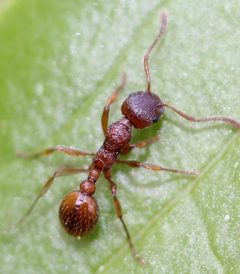
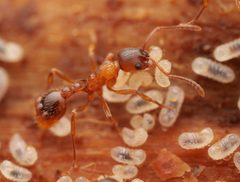
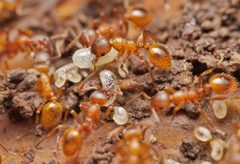
Myrmica rubra is a widespread Palaearctic native to Europe, now in parts of North America and Asia. are reddish-brown with darker , 3.5–5.5 mm in length. The species exhibits complex social structure with both macrogynes and microgynes, and colonies are polygyne and polydomous. It serves as a for several myrmecophilous butterflies and has been documented transmitting viruses through scavenging .
Pronunciation
How to pronounce Myrmica rubra: /mɪrˈmiːkə ˈruːbrə/
These audio files are automatically generated. While they are not always 100% accurate, they are a good starting point.
Identification
are yellowish-brown to reddish, 3.5–5.5 mm long, with smooth and shiny frontal triangle and subspinal areas. Long, slender antennal scapes are distinctive. Queens are larger (5.5–7.0 mm) with enlarged for wing muscles. Males have darker bodies and long projecting hairs on tibiae and —this hairiness distinguishes them from the similar Myrmica ruginodis. Microgynes, a smaller morph formerly considered a separate (M. microrubra), are worker-sized and occur alongside macrogynes.
Images
Habitat
Native occupy meadows, gardens, and open woodlands across Europe. Nests are constructed under stones, fallen trees, and in soil. populations in North America show strong association with moist, cool microhabitats—higher soil moisture and lower soil temperature predict colony locations. Thermal is relatively low, consistent with high-latitude, high-elevation ants.
Distribution
Native range extends across the Palaearctic from Portugal to East Siberia (Transbaikalia), and from northern Greece to the forest-tundra zone. Introduced and in northwestern and northeastern United States and western Canada. Widespread and common in the UK, becoming rarer northward.
Seasonality
occur in late July to mid-August in Europe. No nuptial flights have been observed in North American , though male-only mating swarms have been recorded in Newfoundland, Canada. forage more actively in warmer microhabitat areas.
Diet
Host Associations
- Phengaris alcon - Alcon blue larvae use M. rubra as primary
- Phengaris teleius - Scarce large blue larvae use M. rubra as primary
- Apis mellifera - scavenged Foodborne transmission of Deformed Wing Virus documented from scavenged honeybee pupae
Life Cycle
Colonies are polygyne, containing up to 100 queens per nest. Queens can live up to 15 years. Two morphs exist: macrogynes (typical large queens) and microgynes (smaller, -sized queens). Microgynes were formerly considered a separate social but share gene pool with macrogynes; they may act as intraspecific social parasites or alternative reproductive morphs founding their own colonies. Colony founding occurs after when queens shed wings and establish new nests. Colonies are polydomous with multiple nest sites per colony.
Behavior
are aggressive, often attacking rather than retreating when disturbed, and possess a functional stinger. Unlike Formica ants, they cannot spray formic acid. Trail-following is innate but improves through learning facilitated by older nestmates. Young workers (<1 year) initially follow trails poorly, improving with experience or presence of older workers. Larvae exhibit active begging behavior to solicit food. Undertakers carry dead nestmates up to 3 meters from nests and deposit them at random locations—this does not create cemeteries.
Ecological Role
Significant of and consumer of honeydew in native and invaded ranges. negatively impact native —native ant decrease where M. rubra increases, and increase where M. rubra declines. Some species show reduced abundance with M. rubra presence. Serves as obligate for endangered myrmecophilous butterflies, making it critical for conservation of these species.
Human Relevance
Stinging that can be aggressive when nests are disturbed. Considered in North America, where it establishes in coastal and northern areas with suitable moisture and temperature conditions. Potential management through —a has been associated with colony collapse. Subject of extensive ecological research due to its complex social structure and conservation significance.
Similar Taxa
- Myrmica ruginodisVery similar ; distinguished by distribution pattern (M. ruginodis common throughout UK including northern Scotland, M. rubra common in southern England, rarer northward), and male tibiae/ lack the long projecting hairs characteristic of M. rubra males
- Myrmica sabuletiSimilar ; distinguished by ecological association with short-grass slopes and specific relationship with Maculinea arion (large blue ), which it exclusively hosts rather than M. rubra
- Myrmica scabrinodisSimilar appearance; mandibular gland chemistry differs in behavioral activity of 3-octanol enantiomers
Sources and further reading
- BugGuide
- Wikipedia
- GBIF taxonomy match
- iNaturalist taxon
- NCBI Taxonomy
- Catalogue of Life
- UC Davis Alumnus Marek Borowiec: Remembering E. O. Wilson | Bug Squad
- The Curious Case of the Large Blue Butterfly -- a Conservation Success Story
- Botanizing at St. Joe State Park | Beetles In The Bush
- WGNSS | Beetles In The Bush
- Revision of the Formicidae of North America | Beetles In The Bush
- Comparative phylogeography of the ants Myrmica ruginodis and Myrmica rubra
- Myrmica rubra microhabitat selection and putative ecological impact
- Larval begging behaviour in the antMyrmica rubra
- Foodborne Transmission of Deformed Wing Virus to Ants (Myrmica rubra)
- Brood-rearing behaviour in small cultures of the ant Myrmica rubra L
- Behavioural activity of pure chiral 3‐octanol for the ants Myrmica scabrinodis Nyl. and Myrmica rubra L.
- Trail following Learning by Young Myrmica rubra Workers (Hymenoptera, Formicidae)
- THE DISTRIBUTION OF AN ESTERASE POLYMORPHISM IN MACROGYNES AND MICROGYNES OF MYRMICA RUBRA LATREILLE
- The control of Myrmica rubra workers by queens of their own and other Myrmica species and the interaction between queenless groups of workers
- The Distribution of an Esterase Polymorphism in Macrogynes and Microgynes of Myrmica rubra Latreille
- Ants Myrmica rubra L. and M. scabrinodis Nylander as Intermediate Hosts of a Cestode
- European Fire Ant, Red Ant (suggested common names), Myrmica rubra Linnaeus (Insecta: Hymenoptera: Formicidae: Myrmicinae)