
Carebara
Westwood, 1840
Marauder Ants, Carebara Thief Ants
Species Guides
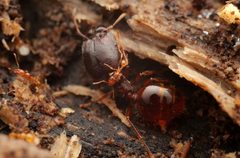
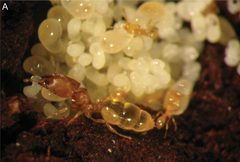
1Carebara is a large of myrmicine ants comprising over 200 distributed worldwide in tropical and Afrotropical regions. These ants are among the smallest known, with often barely visible to the naked . The genus exhibits remarkable worker , including specialized soldier with phragmotic (door-blocking) shapes in some African species. Queens are notably much larger than workers, creating one of the most extreme size dimorphisms in ants. Many species are cryptic inhabitants of soil and leaf litter, with poorly known .
Pronunciation
How to pronounce Carebara: //kæˈrɛbərə//
These audio files are automatically generated. While they are not always 100% accurate, they are a good starting point.
Identification
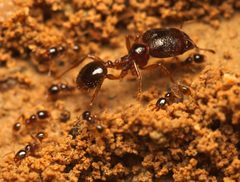
possess 8–11 segmented with a two-segmented club; with 4–7 teeth (rarely 3); palp formula 2,2 or 1,2; and clypeal margin usually with four distinct setae and lacking a central isolated seta. Major workers show with intermediates between small and large forms; largest majors may retain -like characteristics including and ocelli. Some Old World exhibit phragmotic in the major worker subcaste—flattened, disc-shaped heads used to block nest entrances.
Images
Habitat
Soil and leaf litter in tropical and subtropical forests; nests in rotten wood with adherent bark in the Afrotropical region. Some are lestobiotic, nesting near other species. Some species inhabit nests parasitically.
Distribution
Worldwide in tropical regions with highest diversity in the Afrotropical region and Madagascar. Malagasy region: 23 (21 to Madagascar, 1 restricted to Mauritius and Seychelles, 1 in Comoros/Madagascar/Mayotte).
Host Associations
- Macrotermes - inhabits mounds ofCarebara vidua nests established in 2–10% of Macrotermes mounds in Kenya; mated females can produce capable of overpowering and consuming Macrotermes
Life Cycle
Colonies produce of during seasonal rains. are polymorphic: , dimorphic, or with continuous size variation including intermediates in the major worker subcaste.
Behavior
Some exhibit : major use their modified to block nest entrances against intruders. Food hiding has been observed in C. affinis. Multiple ecological roles documented: , scavenging, and seed .
Ecological Role
Soil and leaf litter ; contributes to nutrient cycling and seed . Some are termitophagous.
Human Relevance
Carebara vidua is traditionally consumed as food in some cultures and studied as a potential alternative protein source; contains high protein, iron, and zinc content with antimicrobial and antioxidant properties. The includes the world's smallest known , which has been featured in public education displays.
Similar Taxa
- PheidoleBoth exhibit with major and minor ; Carebara majors may be distinguished by the presence of ocelli and remnants in large individuals, and by the 2-segmented antennal club (Pheidole typically has 3-segmented club)
- TetramoriumSimilar small size and myrmicine features; Carebara distinguished by antennal club segmentation and clypeal setation pattern
Sources and further reading
- BugGuide
- Wikipedia
- GBIF taxonomy match
- iNaturalist taxon
- NCBI Taxonomy
- Catalogue of Life
- Got an Ant Question? | Bug Squad
- The Phil Ward Ant Lab: They Provided the 'Antswers' | Bug Squad
- Colony of Red Ants Roams the Bohart Museum of Entomology | Bug Squad
- predation | Beetles In The Bush | Page 3
- biodiversity | Blog - Part 57
- Edible black ant Smith (Carebara vidua) as human food – A systematic review
- Taxonomy of the ant genus Carebara Westwood (Formicidae, Myrmicinae) in the Malagasy Region
- Food Hiding Behaviour of Ant <i>Carebara affinis</i> (Jerdon)